 |
| Iris |
Showing posts with label Iliad 2. Show all posts
Showing posts with label Iliad 2. Show all posts
Saturday, July 26, 2014
The traditional Trojan assembly
Over on our companion Oral Poetry blog, I continue my series on the Trojan catalogue in conjunction with and parallel to Casey’s blogging of the Catalogue of Ships. In my first post I looked at how the Trojans are introduced in our Iliad and how to understand some of the traditional language used. In my second post I continue looking at Iris's message to the Trojan assembly and how its use of traditional language both sets the “now” of the story into action and simultaneously evokes earlier episodes of the war.


Thursday, April 17, 2014
Oral Poetics and the Homer Multitext
One of the central research questions that drives the Homer Multitext is this: “How do you make a critical edition of an oral tradition, like that of the Homeric Iliad and Odyssey, that spanned a thousand years or more? What is the best way to represent the textual history of songs that were created in and for performance, but survive only in textual forms from later eras?” In our 2010 book, Iliad 10 and the Poetics of Ambush, Mary Ebbott and I attempted to demonstrate that a "multitextual" approach to Homeric poetry is useful not only for understanding the transmission of the text of the epics, but also for better understanding the poetics of oral poetry. We could not have written that book, which is meant to be a sustained demonstration of the workings of oral poetry over the course of an entire book of the Iliad, without the data and tools of the Homer Multitext that were available to us at that time.
As new ways of viewing and working with the surviving documents that transmit Homeric poetry become possible, Mary and I would like to continue to use them to enhance our understanding of the poetics of the Iliad and Odyssey. With that in mind, we have decided to revive a long neglected Oral Poetry blog, which we will maintain along with this one, and in close coordination with one another. The Oral Poetry blog will be devoted primarily to questions of poetics, while we will continue to make posts here about the manuscripts and papyri and what they tell about the system of oral poetry in which the Iliad and Odyssey were composed.
To kick off this phase of the Oral Poetry blog, we are planning a series of posts about the poetics of Iliad 2. You can read my initial post about this work here. You can also read a much older post on this blog about the transmission of the Catalogue of Ships from Book 2 here. It is the special treatment and seemingly controversial place of the Catalogue in the surviving manuscripts and papyri that drives us to try to better understand the poetics of this fascinating record of names and places.
As new ways of viewing and working with the surviving documents that transmit Homeric poetry become possible, Mary and I would like to continue to use them to enhance our understanding of the poetics of the Iliad and Odyssey. With that in mind, we have decided to revive a long neglected Oral Poetry blog, which we will maintain along with this one, and in close coordination with one another. The Oral Poetry blog will be devoted primarily to questions of poetics, while we will continue to make posts here about the manuscripts and papyri and what they tell about the system of oral poetry in which the Iliad and Odyssey were composed.
To kick off this phase of the Oral Poetry blog, we are planning a series of posts about the poetics of Iliad 2. You can read my initial post about this work here. You can also read a much older post on this blog about the transmission of the Catalogue of Ships from Book 2 here. It is the special treatment and seemingly controversial place of the Catalogue in the surviving manuscripts and papyri that drives us to try to better understand the poetics of this fascinating record of names and places.
Wednesday, August 15, 2012
Catalog of Ships Summary Scholia Part Two: Comparing the Υ.1.1 with the Venetus B
A guest post by Stephanie Lindeborg, College of the Holy Cross Class of 2013
In my earlier post on paleographic features in the Catalog of Ships of the Escorial Υ.1.1 manuscript, we established that there are eighteen scholia, located primarily in the interior margin, which summarize the Greek forces by region. Because the Υ.1.1 is often called a “twin” of the Venetus B, it is our practice to run a comparison between the two manuscripts, especially for interesting, unexplored features such as these. My first step was to record and compare the content of each scholion. The Venetus B contains twenty-nine summary scholia, eleven more than I found in the Υ.1.1. The regions noted in the Venetus B scholia match the regions assigned numbers of ships in the poetry. There is no Greek region listed in the poetry that is not accounted for with a scholion in the Venetus B. When I compared the content of analogous scholia between the manuscripts, I found that they were identical. It should be noted that I was working with partial evidence in the Υ.1.1: many of its ship summary scholia have been cut off at the trimmed edges of the manuscript. Because these scholia have a formulaic syntax, I am confident that these “trimmed” scholia are the same in Υ.1.1 as they appear in Venetus B. The presence of eleven more scholia in the Venetus B leads me to believe that the scholia in Υ.1.1 are incomplete. I believe that the eleven scholia “missing” from the Υ.1.1, provided they were ever in the manuscript, had the same content as the scholia that are fully present in the Venetus B.

In my earlier post on paleographic features in the Catalog of Ships of the Escorial Υ.1.1 manuscript, we established that there are eighteen scholia, located primarily in the interior margin, which summarize the Greek forces by region. Because the Υ.1.1 is often called a “twin” of the Venetus B, it is our practice to run a comparison between the two manuscripts, especially for interesting, unexplored features such as these. My first step was to record and compare the content of each scholion. The Venetus B contains twenty-nine summary scholia, eleven more than I found in the Υ.1.1. The regions noted in the Venetus B scholia match the regions assigned numbers of ships in the poetry. There is no Greek region listed in the poetry that is not accounted for with a scholion in the Venetus B. When I compared the content of analogous scholia between the manuscripts, I found that they were identical. It should be noted that I was working with partial evidence in the Υ.1.1: many of its ship summary scholia have been cut off at the trimmed edges of the manuscript. Because these scholia have a formulaic syntax, I am confident that these “trimmed” scholia are the same in Υ.1.1 as they appear in Venetus B. The presence of eleven more scholia in the Venetus B leads me to believe that the scholia in Υ.1.1 are incomplete. I believe that the eleven scholia “missing” from the Υ.1.1, provided they were ever in the manuscript, had the same content as the scholia that are fully present in the Venetus B.
The next step of my comparison was to analyze the physical appearance of the two manuscripts, starting with the outdents that denotes the beginning of each regional section of the poetry in the Υ.1.1. I wanted to know if the Venetus B uses outdents similarly and, if it does, do they occur in the same places as in the Υ.1.1. The Venetus B without a doubt uses outdents, but I found that it does not use outdents with the same frequency as the Υ.1.1 does. The Υ.1.1 outdents every regional section except for Elis and Doulichion. The Venetus B outdents only nine out of the twenty-nine regional sections (Boeotia, Minya, Phocis, Cephallenia, Methone, Oichalia, Ormenius, Argissa, and Magnetes). When my colleague Neil Curran and I looked at the outdents for all of Book 2 in both manuscripts we found a total of 95 outdents in Υ.1.1. Venetus B had only 41, almost 57% fewer. When I compared line numbers, I found that only one of the lines (Iliad 2.344) outdented in Venetus B was not outdented in Υ.1.1, and Υ.1.1 had 53 additional outdents. While this tells us that the two manuscripts were organized by their respective scribes in similar ways, it also makes evident that they are not perfect twins. While their scribes were working with material that was much the same, they had at least some different ideas about structuring their manuscripts.
My next step was to analyze the placement of the scholia in both manuscripts. Because we have “missing” scholia in the Υ.1.1, establishing a pattern in the Venetus B and correlation between the two manuscripts could help us determine the would-be locations of the “missing” scholia. I compared placement between the manuscripts by noting which line of the main text corresponded with the beginning of each scholion. I found that most (15 out of 18) of the shared scholia began in the same position relative to the main text, or were off by a line or two at most. The most notable exceptions were the first two scholia in both manuscripts. In Υ.1.1, the placement of the first scholion is already irregular just in context of the Υ.1.1 manuscript because it appears well after the lines that discuss Boeotia. In the Venetus B, the scholia on Boeotia and Minya both appear well after their reference in the main text. Both manuscripts avoid putting summary scholia on the first folio that starts the Catalog of Ships, but, while both manuscripts are irregular, the placement of their first scholia is different. Aside from the first two scholia in both manuscripts, I found that the placement of scholia in the Venetus B matches the placement of the scholia in the Υ.1.1 (for a summary of this placement see the chart below). This pattern and correlation allows us to predict on which folios the “missing” scholia should have appeared and roughly where in the margin we should be looking for the visual evidence.
Based on comparison with the Venetus B, I believe that scholia are missing from the following folios of the Υ.1.1: 32r, 33r, 34v, 35r, 35v, and 37r. Of these folios 32r, 33r, 35r, and 37r have narrow interior margins. In this situation it is plausible that the summary scholia were cut off when the manuscript was trimmed and rebound. To see for yourself, here is folio 32r (click on the caption to open the image in a zoomable format):
 |
| Escorial Y.1.1, folio 32r: example of a narrow interior margin |
Exceptions to this pattern are folios 34v and 35v, which have margins that appear wide enough to hold a scholia. While we might not be able to hope for all of the scholia to be present on folios such as these, it is surprising not to see any traces in the interior margins. If you compare a folio like 35v to 32r you can see the difference in the margin size.
 |
| Escorial Y.1.1, folio 35v: example of a wider interior margin |
When I compare the size of the margins to folio sides that have summary scholia but only in part (such as 36r), I am even more surprised that these folio sides with wider margins lack any trace of summary scholia.
 |
| Escorial Y.1.1, folio 36r, example of narrow margin on which ship summary scholia have been cut off in rebinding |
 |
| Close-up of one of the ship summary scholia from 36r (Methone) that has been cut off in rebinding |
The lack of scholia on 34v and 35v is the strongest evidence for my hypothesis that the scribe of the Υ.1.1 did not include as many summary scholia as in the Venetus B from the start.
In the previous post, we considered whether the scribe may have eliminated scholia about regions he deemed less important. Based only on my knowledge of the Υ.1.1, I could not exclude any of the “missing” scholia from the list and so could not come to a confident conclusion on that question. If we were to eliminate from the list the scholia that appear on 32r, 33r, 35r, and 37r because it is more likely they were originally there, our list of supposedly unimportant places narrows to: Rhodes, Syme, Phylace, and Pherae. This narrowed list still does not lend much credence to the assumption. Rhodes in particular is especially noted in the epic poetry with praises for its abundant resources and its connection to Tlepolemus, a son of Heracles.
My last point of comparison is in the quire arrangement. The Venetus B is organized mostly into quaternions, and has a total of 42 quires. The Υ.1.1 is much more irregular in terms of the number of folio in a quire (it ranges from 6 to 8), but also contains a total of 42 quires. The exact content of all the corresponding quires is a subject for future investigation. For Book Two we can say that the first five summary scholia appear at the end of the fourth quire in both manuscripts, and subsequently the rest of the scholia appear in each manuscript’s fifth quire. This is interesting to us when we consider the claim that the manuscripts are “twins.” The fact that the content of the quires is similar (down to what appears in which quire), at least true for this specific situation, is strong evidence for the claim.
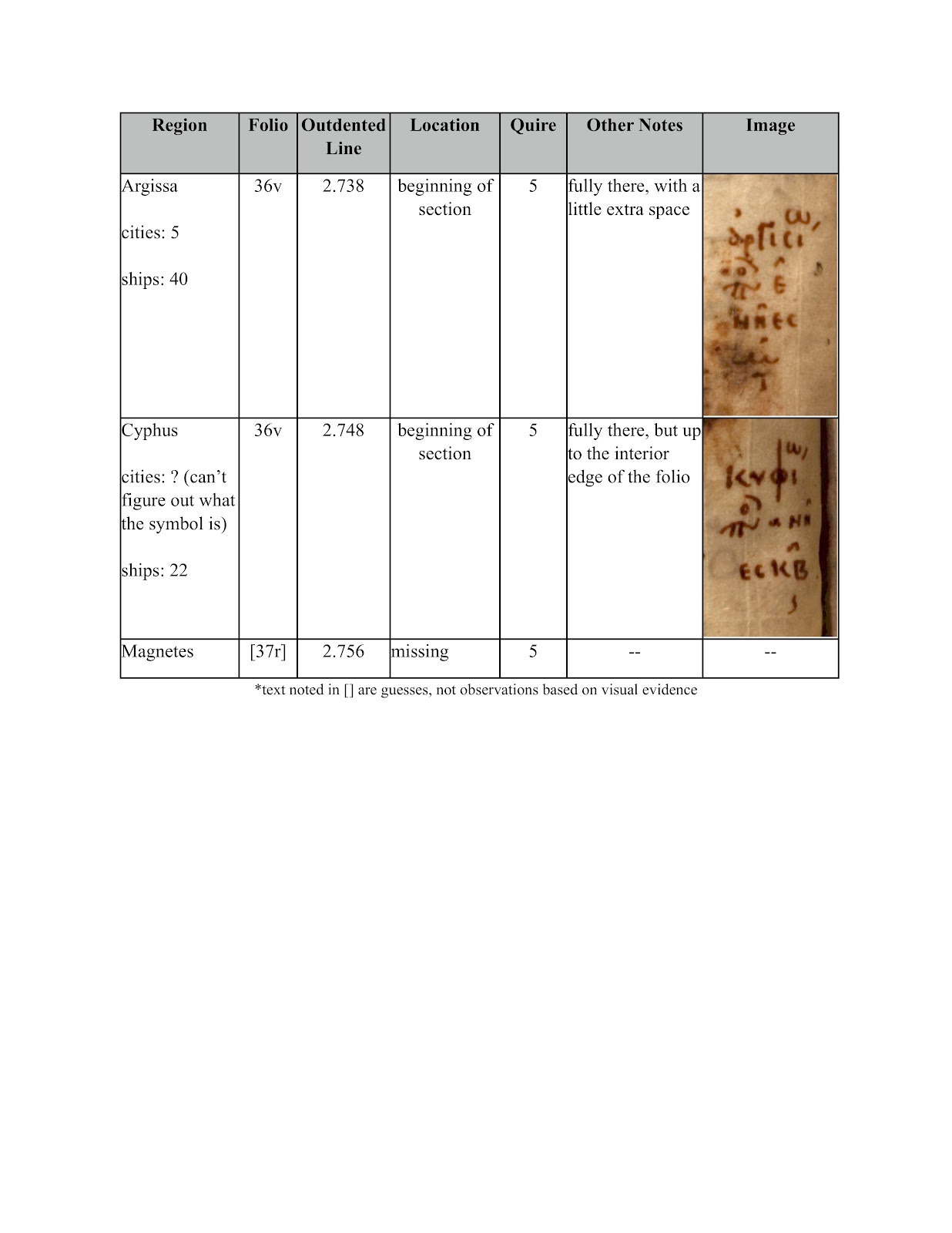
In my investigation of the Venetus B’s relationship to the Υ.1.1, I constructed a comparative table to aid my analysis. It proved especially helpful to compare numerous features at the same time. Below is the table, which lists folio sides, outdents, relative location of the scholia, and quire number.
Saturday, August 11, 2012
Catalog of Ships Summary Scholia in the Escorial Υ.1.1
Guest post by Stephanie Lindeborg, College of the Holy Cross Class of 2013
The Catalog of Ships is the last half of Iliad Book 2, in which the forces of the Greek army are listed and summarized. Looking at the Escorial Υ.1.1 manuscript, I, along with my colleague Neil Curran, discovered that the scribe included paleographic features in addition to the main scholia in conjunction with the Catalog. The Υ.1.1 and the Venetus B feature “summary scholia” that denote the number of cities (if applicable) in each Greek region and the number of ships they brought. (The scholia in Venetus B will be discussed in more depth in a subsequent post). It would appear that these numbers are derived directly from the poetry. It is easy enough to see that the number of ships are directly stated in the poetry. The number of cities would appear to be the number of the cities listed by name in each section of the main text. For an example of what I mean by “summary scholia,” the scholion on 31v of the Υ.1.1 reads: “Λοκρῶν πολεὶς Η νῆες Μ” and translates to: “The eight cities of Locris [brought] forty ships.” (The caption links to the image of the full page with this portion highlighted.)
The format is almost always the same in each summary scholion (i.e., region, number of cities, number of ships). Within the Catalog further visual features used by the scribe help clarify where each section of the catalog starts. In the Υ.1.1, this visual distinction is accomplished by outdenting the beginning line of each regional section:
For the purposes of these investigations, I define the regions as each place which is said in the poetry to have brought a specific number of ships (so because the poetry says Mycenae brought one-hundred ships, Mycenae is noted as a unique region). The names of each region I derive from the scholia which summarize them. The Υ.1.1 outdents all but two of the twenty-nine so defined regions.
The twenty-nine Greek regions include, in order of appearance: Boeotia, Minya, Phocis, Locris, Euboea, Athens, Salamis, Argos, Mycenae, Lacedaemonia, Pylos, Arcadia, Elis, Doulichion, Cephallenia, Aetolia, Crete, Rhodes, Syme, Nisyros, Phthia, Phylace, Pherae, Methone, Oichalia, Ormenius, Argissa, Cyphus, and Magnetes. Only eighteen of these regions are marked by summary scholia in the Υ.1.1 in its current state, leaving eleven without. The following regions are missing such a summary scholion: Athens, Salamis, Argos, Arcadia, Rhodes, Syme, Nisyros, Phthia, Phylace, Pherae, and Magnetes. I will consider two possibilities to account for the missing scholia. The first is that when the manuscript was trimmed and rebound these scholia were cut off. The second possibility is that these scholia were never added to the manuscript in the first place, omitted either purposely or accidentally by the scribe.
The evidence that they were lost in the trimming process is compelling. Of the eighteen scholia that are present only nine (Locris, Euboea, Mycenae, Lacedaemonia, Pylos, Elis, Doulichion, Argissa, and Cyphus) are present in their entirety and very few of those leave any space between the edge of the scholion and the edge of the folio. Four of the scholia (Boeotia, Minya, Phocis, and Cephallenia) are cut off about halfway through but are still fairly discernible. Five (Aetolia, Crete, Methone, Oichalia, and Ormenius) are almost entirely cut off, containing at most only a few letters. These were more difficult to identify as their names were not easily picked out. My identification of these scholia was made based on the content of the main lines and what I could make out (for example I identified Ormenius because it was near the lines on Ormenius in the main text and the numeral for forty was visible, which matches the number stated in the main text). I further cross-checked these identifications with the Venetus B, which I will discuss in a subsequent post.
If we could assume that the eleven missing scholia were cut off when the manuscript was trimmed, then we could simply lament the loss of the physical evidence and concern ourselves with other questions such as the twin nature of the Υ.1.1 and the Venetus B manuscripts. However, we must consider the possibility that some of these scholia never made it into the manuscript. The simplest explanation in that case would be that the scribe unintentionally omitted them. The gaps of missing scholia are restricted to a whole folio side, meaning there are no folio sides that have some but not all of the scholia they could have. It is possible that the scribe accidentally skipped a whole folio side when adding the ship summaries.
After ascertaining the quire arrangement of the Υ.1.1, I was able to look at whether the quires had anything to do with why these summary scholia are missing in the Υ.1.1. Because manuscripts were typically composed in several passes, it is a serious possibility that scribes could accidentally skip entire quires when adding certain features. This is something we always investigate when we have seemingly incomplete sets of features. The Catalog begins on 30v and the summary scholia start appearing on 31r. 30v through 31v are the last three folio sides of the fourth quire. 32r starts the fifth quire which continues through 39v, the end of the Catalog and the end of Book 2. The first three scholia that are missing (Athens, Salamis, and Argos) ought to appear at the beginning of the fifth quire. It is also probable that these three were cut off when the manuscript was rebound. Since the rest of the missing scholia are contained within a quire that has many of the summary scholia present, the theory that the scribe could have skipped over an entire quire is impossible.
The other possibility is that the scribe purposely excluded certain scholia, perhaps because he deemed them of lesser importance. But that motivation would mean that the “less important” scholia may have included: Athens, Salamis, Argos, Arcadia, Rhodes, Syme, Nisyros, Phthia, Phylace, Pherae, and Magnetes. It's rather hard to believe that this list of places could be deemed unimportant, when Phthia is the homeland of Achilles and other great heroes are named in conjunction with these places (i.e., Ajax and several sons of Heracles). There is no evidence to say that the scribe skipped places that did not bring a large number of ships for some of the missing ones brought as many as forty ships (Phylace) and he includes places that brought as few as seven (Methone). There seems to be no distinguishing characteristic that sets aside the missing places from those that are present.
In the Υ.1.1, these scholia raise questions about how the manuscript was composed. One of the striking features in the Υ.1.1 are the first three summary scholia. While all the others in the Υ.1.1 are located in the interior margin, the first three in the Υ.1.1 are instead placed in the exterior margin. There is no clear reason as to why these scholia are located in the exterior, nor why the scribe puts no other summary scholia in the exterior. We can only surmise that it was a conscious choice made by the scribe and that it made more sense to him not to continue putting the scholia in the exterior. The fact that these scholia are in the exterior tells us that they were planned to fit outside of the main scholia and so were, more likely than not, written after the main scholia. They were either written before the scribe finished with a folio or as a second pass through Book 2. If the former is true, that might explain why some scholia are missing. Including another type of scholia in another location on the page might have complicated the process enough that the scribe forgot to include some of the scholia he was supposed to. If the scribe were adding the scholia as a separate set, going back through the entire Catalog to add them in a separate pass specifically for that purpose rather than as he worked on each folio individually, then it is highly unlikely that he would have forgotten to include some of them. I conclude, therefore, that the summary scholia were probably not added in a second pass in the Υ.1.1.
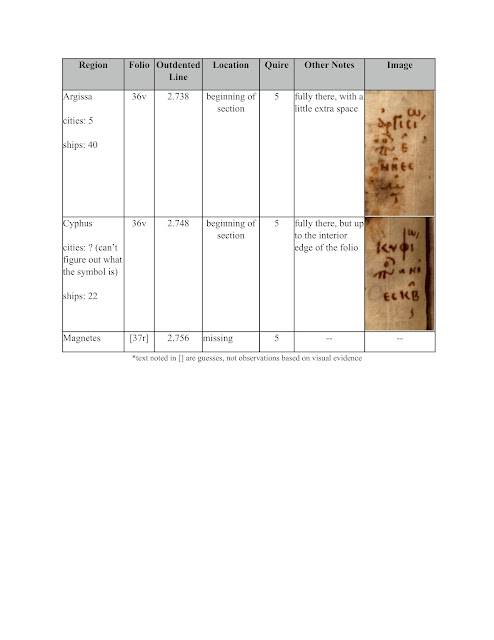
While conducting my investigation, I found it particularly helpful to organize my data into a table. Below is this table which includes the content of each summary scholion, the folio it appears on, the outdented line associated with the region, the relative location of the scholion, the quire number, and another other important notes on the state of the scholion.


The Catalog of Ships is the last half of Iliad Book 2, in which the forces of the Greek army are listed and summarized. Looking at the Escorial Υ.1.1 manuscript, I, along with my colleague Neil Curran, discovered that the scribe included paleographic features in addition to the main scholia in conjunction with the Catalog. The Υ.1.1 and the Venetus B feature “summary scholia” that denote the number of cities (if applicable) in each Greek region and the number of ships they brought. (The scholia in Venetus B will be discussed in more depth in a subsequent post). It would appear that these numbers are derived directly from the poetry. It is easy enough to see that the number of ships are directly stated in the poetry. The number of cities would appear to be the number of the cities listed by name in each section of the main text. For an example of what I mean by “summary scholia,” the scholion on 31v of the Υ.1.1 reads: “Λοκρῶν πολεὶς Η νῆες Μ” and translates to: “The eight cities of Locris [brought] forty ships.” (The caption links to the image of the full page with this portion highlighted.)
 |
| Summary scholion for Locris on Υ.1.1 31v |
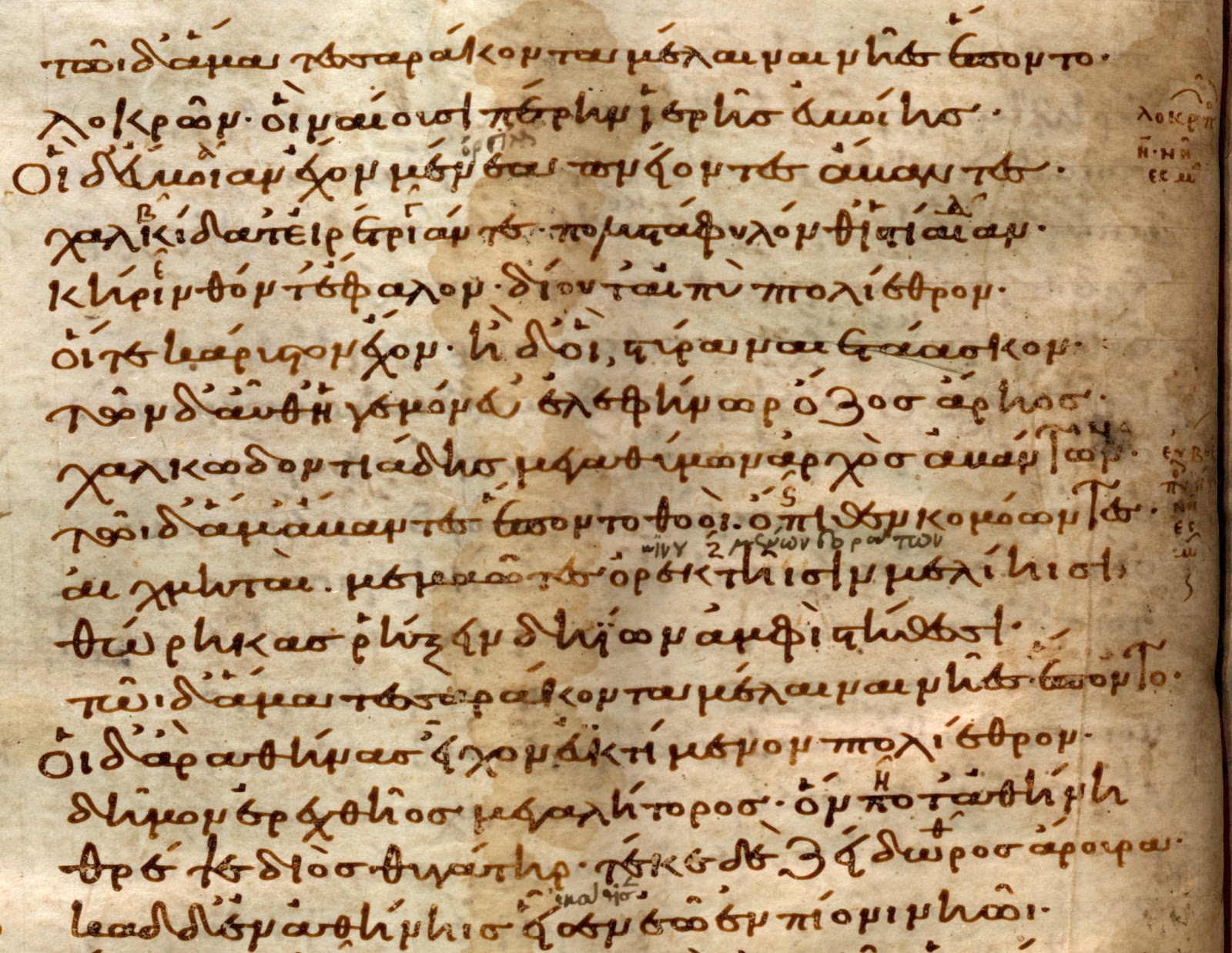 |
| Note the 'outdenting' of the two lines beginning with οἱ, Iliad 2.536 and 2.546, on Υ.1.1 31v |
The twenty-nine Greek regions include, in order of appearance: Boeotia, Minya, Phocis, Locris, Euboea, Athens, Salamis, Argos, Mycenae, Lacedaemonia, Pylos, Arcadia, Elis, Doulichion, Cephallenia, Aetolia, Crete, Rhodes, Syme, Nisyros, Phthia, Phylace, Pherae, Methone, Oichalia, Ormenius, Argissa, Cyphus, and Magnetes. Only eighteen of these regions are marked by summary scholia in the Υ.1.1 in its current state, leaving eleven without. The following regions are missing such a summary scholion: Athens, Salamis, Argos, Arcadia, Rhodes, Syme, Nisyros, Phthia, Phylace, Pherae, and Magnetes. I will consider two possibilities to account for the missing scholia. The first is that when the manuscript was trimmed and rebound these scholia were cut off. The second possibility is that these scholia were never added to the manuscript in the first place, omitted either purposely or accidentally by the scribe.
The evidence that they were lost in the trimming process is compelling. Of the eighteen scholia that are present only nine (Locris, Euboea, Mycenae, Lacedaemonia, Pylos, Elis, Doulichion, Argissa, and Cyphus) are present in their entirety and very few of those leave any space between the edge of the scholion and the edge of the folio. Four of the scholia (Boeotia, Minya, Phocis, and Cephallenia) are cut off about halfway through but are still fairly discernible. Five (Aetolia, Crete, Methone, Oichalia, and Ormenius) are almost entirely cut off, containing at most only a few letters. These were more difficult to identify as their names were not easily picked out. My identification of these scholia was made based on the content of the main lines and what I could make out (for example I identified Ormenius because it was near the lines on Ormenius in the main text and the numeral for forty was visible, which matches the number stated in the main text). I further cross-checked these identifications with the Venetus B, which I will discuss in a subsequent post.
If we could assume that the eleven missing scholia were cut off when the manuscript was trimmed, then we could simply lament the loss of the physical evidence and concern ourselves with other questions such as the twin nature of the Υ.1.1 and the Venetus B manuscripts. However, we must consider the possibility that some of these scholia never made it into the manuscript. The simplest explanation in that case would be that the scribe unintentionally omitted them. The gaps of missing scholia are restricted to a whole folio side, meaning there are no folio sides that have some but not all of the scholia they could have. It is possible that the scribe accidentally skipped a whole folio side when adding the ship summaries.
After ascertaining the quire arrangement of the Υ.1.1, I was able to look at whether the quires had anything to do with why these summary scholia are missing in the Υ.1.1. Because manuscripts were typically composed in several passes, it is a serious possibility that scribes could accidentally skip entire quires when adding certain features. This is something we always investigate when we have seemingly incomplete sets of features. The Catalog begins on 30v and the summary scholia start appearing on 31r. 30v through 31v are the last three folio sides of the fourth quire. 32r starts the fifth quire which continues through 39v, the end of the Catalog and the end of Book 2. The first three scholia that are missing (Athens, Salamis, and Argos) ought to appear at the beginning of the fifth quire. It is also probable that these three were cut off when the manuscript was rebound. Since the rest of the missing scholia are contained within a quire that has many of the summary scholia present, the theory that the scribe could have skipped over an entire quire is impossible.
The other possibility is that the scribe purposely excluded certain scholia, perhaps because he deemed them of lesser importance. But that motivation would mean that the “less important” scholia may have included: Athens, Salamis, Argos, Arcadia, Rhodes, Syme, Nisyros, Phthia, Phylace, Pherae, and Magnetes. It's rather hard to believe that this list of places could be deemed unimportant, when Phthia is the homeland of Achilles and other great heroes are named in conjunction with these places (i.e., Ajax and several sons of Heracles). There is no evidence to say that the scribe skipped places that did not bring a large number of ships for some of the missing ones brought as many as forty ships (Phylace) and he includes places that brought as few as seven (Methone). There seems to be no distinguishing characteristic that sets aside the missing places from those that are present.
In the Υ.1.1, these scholia raise questions about how the manuscript was composed. One of the striking features in the Υ.1.1 are the first three summary scholia. While all the others in the Υ.1.1 are located in the interior margin, the first three in the Υ.1.1 are instead placed in the exterior margin. There is no clear reason as to why these scholia are located in the exterior, nor why the scribe puts no other summary scholia in the exterior. We can only surmise that it was a conscious choice made by the scribe and that it made more sense to him not to continue putting the scholia in the exterior. The fact that these scholia are in the exterior tells us that they were planned to fit outside of the main scholia and so were, more likely than not, written after the main scholia. They were either written before the scribe finished with a folio or as a second pass through Book 2. If the former is true, that might explain why some scholia are missing. Including another type of scholia in another location on the page might have complicated the process enough that the scribe forgot to include some of the scholia he was supposed to. If the scribe were adding the scholia as a separate set, going back through the entire Catalog to add them in a separate pass specifically for that purpose rather than as he worked on each folio individually, then it is highly unlikely that he would have forgotten to include some of them. I conclude, therefore, that the summary scholia were probably not added in a second pass in the Υ.1.1.
While conducting my investigation, I found it particularly helpful to organize my data into a table. Below is this table which includes the content of each summary scholion, the folio it appears on, the outdented line associated with the region, the relative location of the scholion, the quire number, and another other important notes on the state of the scholion.


Saturday, February 25, 2012
Exegesis of the Iliad and Odyssey of Homer


Like that of the Venetus A, the front matter of the Iliad manuscript known as E4 (Allen, = West F, Escorialensis Ω.I.12) has been a source of confusion and speculation for scholars. (For the Venetus A, see Allen 1899 and Hecquet 2009 in Recapturing a Homeric Legacy). While trying to understand this odd assembly of Homeric reference material—material which includes lives of Homer, a Proclan summary of the Cypria, an excerpt from the Batrachomyomachia (“Battle of Frogs and Mice”), and an excerpt from a work of the grammarian Tryphon, among other things—I came across a text on folio 2r entitled ἐξήγησις τῆς ἰλιάδος καὶ ὀδυσσείας ὁμήρου or "Exegesis of the Iliad and Odyssey of Homer." Not knowing what this work was, I typed the whole phrase into Google, and discovered this manuscript (Harley 5601), now on-line thanks to the British Library's Digitized Manuscripts initiative (funded by the Stavros Niarchos Foundation).
Like E4, Harley 5601 contains hypotheses before each book of the Iliad. It is clear, however, that those of Harley 5601 are not copied from E4, because the hypothesis for book 2 in Harley 5601 is much more fuller than the corresponding hypothesis in E4 (which seems to have been abbreviated by the scribe because of lack of space). (In E4, all books of the Iliad begin on the recto side of a folio. On the adjacent verso side, the scribe writes usually two hypotheses along with scholia if there is room. In this case, the end of book 1 three quarters of the way down the page left him very little space for the hypotheses to book 2.) The actual wording of the hypotheses (that of Harley 5601 and the second hypothesis for book 2 in E4) is the same until the scribe runs out of room on E4.
Harley 5601 postdates E4 by many centuries, but it seems clear that share a partial ancestor that predates E4. That ancestor had the prolegomena that these manuscripts share, and, very likely, one set of hypotheses. Their texts of the Iliad, however, have different ancestors. Perhaps E4's had the additional set of hypotheses that Harley 5601's did not, or perhaps that other set of hypotheses in E4 came from still another source.
Many questions remain about how these two manuscripts might be related. I am grateful to the Niarchos Foundation and the British Library for making these images freely available, so that further study can now take place—by anyone that wants to. These two manuscripts have almost certainly never been, and never will be, in the same room together. But now, if you have a big screen, you can zoom up on them in great detail, side by side.
Tuesday, February 14, 2012
The Catalogue of Ships

In this post I'd like to discuss the special treatment of the so-called "Catalogue of Ships" (Iliad 2.494–877) in the Venetus A and E4 manuscripts of the Iliad, as well as in the Venetus B and E3. The Catalogue of Ships, in which the Achaean and Trojan and allied forces at Troy are listed and described, has long been a subject of scholarly controversy, perhaps dating back to antiquity, and so it is worth making note of how it is treated in our oldest manuscripts of the poem. In the end, as we have seen several times now in other posts, E4 will be shown to have an intriguing connection with the scholarly material recorded in the Venetus A, and all four manuscripts will have something to say about the limitations of traditional critical editions of the Iliad.
Why is the Catalogue of Ships so controversial? It is by no means the only catalogue in surviving Homeric poetry, but at nearly four hundred verses in length it is by far the longest. Its placement in the narrative, at the start of a battle in the tenth year of the war, seems odd. The catalogue follows a circuitous geographical progression that begins in Boeotia, and the region of Boeotia and its neighboring areas are disproportionately represented. The Catalogue seems to reflect, for the most part, the political geography of Bronze Age Greece, but there are many exceptions and aspects that are hard to explain. As Oliver Dickinson (2011) has recently concluded:
All in all, the Catalogue is a strange compilation, and it does not seem possible to devise any rational explanation for its peculiarities. Here, as with many Homeric problems, the lack of pre-Homeric or contemporary "heroic" poetry is a major obstacle to the creation of plausible hypotheses. The most that can be safely said is that the Catalogue is likely to have been compiled from materials of different origins and dates and that care has been taken to harmonize it to other Greek traditions; but, although in some parts it does show a degree of historical consistency, on the whole it is most unlikely to bear any resemblance to the probable political configuration of those parts of Greece that it covers at any time period.In fact, many of the controversies associated with the Catalogue of Ships can be at least partially explained if we understand it to have been composed as part of a traditional system of oral composition-in-performance that evolved over many centuries. Names and places that seem obscure to us would have had a prominent place in the epic tradition at one time or another. Some places that flourished in the Bronze Age no doubt became obscure already even for ancient audiences of the Archaic period, but a brief record of their heroes was preserved and eventually crystallized as part of the Catalogue. In many ways, such a catalogue functions as an index to the full diachronic expanse of the Epic Tradition itself. As for the oddity of having the Achaean and Trojan forces listed in the tenth year of the war, we can easily see how, in an oral tradition in which the song is composed anew each time, episodes could be rearranged to meet the needs of the current composition. It has long been understood that there are many episodes in the Iliad that logically belong far earlier in the story of the Trojan War (such as the scene in Book 3 in which Helen points out the Achaean heroes to Priam and the old men watching from the walls, and indeed the duel for Helen by Paris and Menelaos, which also takes place in that book). As the Iliad evolved into the monumental poem that we know, those chronologically earlier episodes came to be folded into the narrative structure of the poem, and became integral to it.
Understanding the traditional and oral nature of the Catalogue does not explain all of the questions associated with it, however, and the controversies it has generated may explain why it is missing from several manuscripts of the Iliad, including the Townley and the Genavensis and a 3rd-century papyrus. The Venetus A, the Venetus B, E3, and E4 all include the Catalogue, but it is formatted in such a way that sets it apart visually.
Let's look first at E4, and the compare it to the other manuscripts. If you look at Folio 21v (you may want to look first, for comparison, at Folio 21r), you'll quickly see that it is not a typical one. The folios of E4 usually have two columns of equal-sized text on each folio, and these columns are surrounded by scholia. The left columns contain the text of the poem and the right columns consist of a paraphrase. Here we are in the middle of Book 2, but what we find is in fact a title page.
Each book of the Iliad in E4 has a title page that spreads over two folios, from the verso of one folio on the left side to recto of the other on the right. (See, e.g., folio 187v and 188r.) On the left side page, scholia surround a central text block, which typically includes scholia followed by one or more (usually two) brief prose summaries, or hypotheses. These hypotheses are transmitted in a variety of manuscripts, including Ve1 (= West Z, Rom. Bibl. Nat. Gr. 6 + Matrit. 4626), a ninth-century manuscript containing “D” scholia that is older than any of our minuscule manuscripts of the Iliad itself. After the hypothesis of each book, on the facing page and above the main text of the poem and its paraphrase, comes a title line (e.g. “rhapsody 10 of the Iliad of Homer”) followed by a one-verse summary of the plot of the book in dactylic hexameter. The title line is placed over the column of text that contains the Iliad, while the summary is placed over the column that contains the paraphrase.
Folio 21v of E4 in fact follows exactly the pattern that we find for the beginning of each book of the Iliad. A large portion of the page is taken up by a block of scholia, which is itself surrounded by other scholia. (The sources of these distinct groups of scholia will be explored in another post.) Next we find: ὑπόθεσις τῆς Βοιωτίας written in crimson ink at the center of the page. Instead of "Rhapsody ___," the Catalogue of Ships has been given the title of Βοιωτία, a title which may well have been a traditional way of referring to it in antiquity, reflecting the central importance of the region of Boeotia in the Catalogue. And, as for other books in E4, we find two hypotheses.

A question immediately springs to mind. Where do these hypotheses come from? Has the Catalogue always been treated as a separate composition, such that hypotheses survive for it just as for the twenty-four books of the Iliad? A closer look, however, reveals that these hypotheses are not quite the same as those of other texts. For one thing, they have lemmata: each begins with a quotation of Iliad 2.494. The other hypotheses in E4 have no such lemmata. Where there are two hypotheses for other books, the second one is usually preceded by ἄλλως or καὶ ἄλλως. That is not the case here. Moreover, if we turn to Folio 22r, we find other differences from other books. Though the folio is formatted much as the initial folio of a book of the Iliad would be in E4, there is no paraphrase in the right column. The right column is instead taken up with scholia. (This holds true for the entire length of the Catalogue of Ships in E4.) There is no metrical summary, and instead of a title, we find merely the ὑπόθεσις τῆς Βοιωτίας of the previous folio repeated (even though what follows is poetry, not a summary).

If the hypotheses for the Catalogue in E4 were related to those of the other books of the Iliad, we would expect to find them in the other manuscripts that preserve these hypotheses, such as Ve1, but we do not. To be more precise, they do not survive as hypotheses. They must have another source, and in fact we do find them preserved among the "D" scholia as scholia. The source seems to be most likely the same one that preserves the other scholia with lemmata in E4, scholia which, as we have seen, are related to the scholarly material that we find in the Venetus A. So let's turn now to the Venetus A (folio 34r), and see what we find there.
If we look at folio 34r of the Venetus A, we see that line 2.494 immediately follows upon what precedes it. There is no gap in the text nor a title line nor a metrical summary. But other features do indeed set it apart. The first letter of 2.494 in the Venetus A is a beautiful capital beta, such as you find at the beginning of books. Moreover a decorative line has been placed between verses 493 and 494. It is as if the scribe is aware of a tradition that treats the Catalogue of Ships as a separate unit, and formats it accordingly.

If we look above and to the right of the text block, we find several scholia that are easy to spot with their semiuncial lemmata—a quotation of verse 494. What follows the lemma of the first of these scholia is what has been formatted as the first hypothesis of E4. The comment following the second of these lemmata is very close to what has been formatted as the second hypothesis in E4:

If we compare the Venetus B (folio 31v) and E3 (folio 30v), we find that they too, like E4, format the start of the Catalogue of Ships as if it were the beginning of a new book of the Iliad. These manuscripts do not contain hypotheses for any of the books, so we would not expect to find one here. They both have a title line however: ἀρχὴ τῆς Βοιοτίας. And they both have an initial capital, as in the Venetus A.

Among the oldest manuscripts of the Iliad, we have seen that two omit the Catalogue of Ships entirely, and four format it in such way that make it clear that it was perceived as being in some sense a separate composition, or else its own "whole," much as the other books or "rhapsodies" of the Iliad. What does this formatting signify? Might it reflect, in some dim way, an ancient performance tradition, in which the Catalogue was performed on its own as a unit, as has been suggested for the individual books of the poem? (Cf. Aelian, Varia Historia 13.14, where the Catalogue of Ships is named explicitly as one of the episodes that "the ancients" used to perform separately.) Or is it the result of scholarly debate in antiquity, debates which may have deemed the Catalogue unHomeric? I don't yet have answers to these questions. But visual inspection reveals once again what is otherwise obscured in a traditional edition. If we did not have these images, we would only know that A, B, E3, and E4 include the Catalogue of Ships, and we would be unable to see how it has been so carefully set apart from the rest of Book 2 in each manuscript.
Further reading:
Dickinson, O. 2011. "Catalogue of Ships." In M. Finkleberg, ed. The Homer Encyclopedia. Blackwell.
Tsagalis, C. 2010. "The Dynamic Hypertext: Lists and Catalogues in the Homeric Epics." In C. Tsagalis. ed. Homeric Hypertextuality. Trends in Classics 2. De Gruyter. 323–347.
Subscribe to:
Posts (Atom)