Showing posts with label Escorial manuscripts. Show all posts

Monday, March 7, 2016

Escorialensis Ω.I.12 introduction posted - scholars wanted!

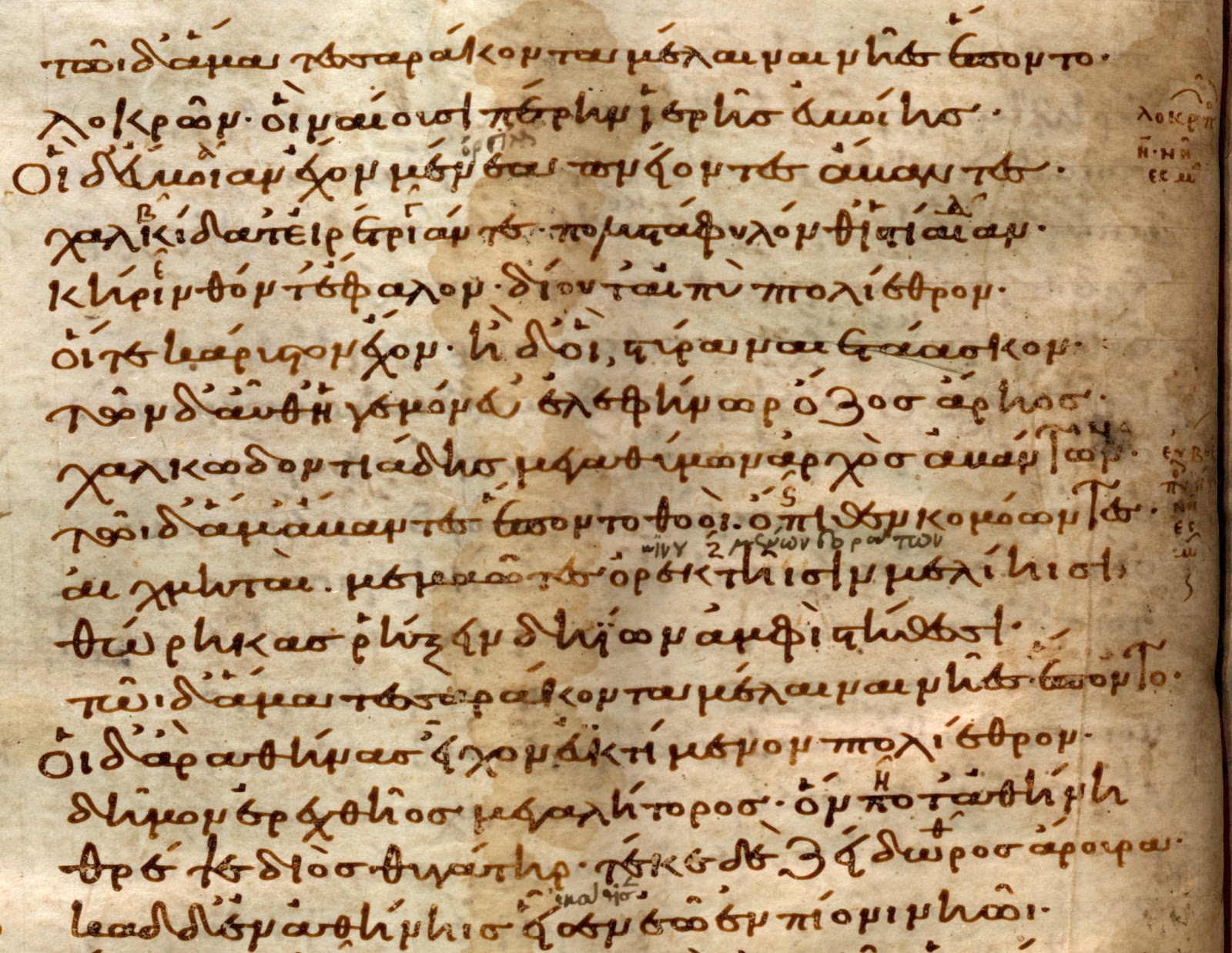
Folio 188 recto of Escorialensis Ω.I.12
Escorialensis Ω.I.12 (= Allen E4; West F), an eleventh-century CE manuscript of the Iliad now housed in the library of the Escorial in Spain, is not a manuscript that has received much scholarly attention, despite its antiquity and despite the fact that the layout and the organization of its text and scholia set it apart from the other tenth- and eleventh-century manuscripts of the Iliad with scholia. And yet these distinctions immediately raise many fascinating questions about the manuscript’s history and sources. Where was this manuscript constructed? Why was it acquired for Philip’s library, in addition to the Iliad manuscript known as Escorialensis Υ.I.1? Are the two manuscripts related in any way, or is it simply a coincidence that they were both for sale in Venice in 1572 and both were purchased for Philip’s library? Is the unusual layout of Escorialensis Ω.I.12 reflective of a separate channel of transmission for its text and scholia? What kind of scholia does it contain and how do they relate to those of other manuscripts?

A preliminary exploration of this manuscript is now available on the Homer Multitext site. This introduction is meant to be an invitation to others to study the manuscript in more depth using the high-resolution images we acquired in 2010. We encourage you to build on this work, and let us know about any publications or presentations that result. 

Saturday, August 30, 2014

New content, new contributors


Eric Raymond popularized the phrase "release early, release often" as a philosophy for software development. It works for digital scholarship, too.

We're happy to announce today an early release of a facsimile browser incorporating new material from our photography in the Escorial last summer. The digital facsimile edition requires data about the manuscripts (including what folios appear in what sequence), an index aligning each folio with a canonical citation of lines of the Iliad, and an index identifying which side of which folio each image illustrates. A group of dedicated and talented volunteers (some shown in the photo) has been meeting regularly on Friday afternoons to put this material together for the Escorial Υ.1.1 manuscript, prior to beginning work on a full diplomatic edition of the text (as others are already doing for the Venetus A and Venetus B codices).

Perhaps even more remarkable than the volunteers' rapid mastery of Escorial Υ.1.1's Byzantine script is the fact that all of the students are in their first year of Greek. If you're not accustomed to learning about the transmission of Homer from first-year Greek students, a Friday afternoon with this group is enlightening.


You will undoubtedly see postings on this blog in the future announcing further releases of material from "Team Escorial Υ.1.1." In addition to the puzzles they've had to solve to make today's release available, they are compiling careful observations that will lead to a helpful guide to the paleography of Escorial Υ.1.1, and have already noted a number of unpublished or unappreciated discrepancies bewteen Escorial Υ.1.1 and other manuscripts that are forcing all of us working on the Homer Multitext project to reassess entirely the traditional scholarly views on the (b) family of manuscripts of the Iliad.

The Escorial Υ.1.1 group has currently indexed more than half of the manuscript: we're including folios 1 recto - 109 recto (covering Iliad books 1-8) in today's release.

Our profound thanks to all members of the group (alphabetically):

  • Matthew Angiolillo
  • Neil Curran
  • Maria Jaroszewicz
  • Alex Krasowski
  • Becky Musgrave
  • Kathleen O'Connor
  • Anne Salloom
  • Megan Whitacre


Monday, June 23, 2014

The scribal process of handling “forgotten” lines in two manuscripts of the Iliad: Escorial Upsilon 1.1 and Venetus A

A guest post by Holy Cross undergraduate research teams: Debbie Sokolowski ’14 and Drew Virtue ’17; Becky Musgrave ’14 and Chris Ryan ’16


Often when the Homer Multitext team edits manuscripts throughout the year we encounter irregularities in the way the folios are laid out. One case of this is the way scribes deal with lines of the Iliad that they either forgot or decided not to include within the main text. Debbie Sokolowski and Drew Virtue discovered one example of this in their editing of book 22 in Venetus A this year, on folio 286 verso. The lines are Iliad 22.210–22.213:

ἐν δ’ ἐτίθει δύο κῆρε τανηλεγέος θανάτοιο.
τὴν μὲν Ἀχιλλῆος. τὴν δ᾽ Ἕκτορος ἱπποδάμοιο·
ἕλκε δὲ μέσσα λαβών. ῥέπε δ᾽ Ἕκτορος αἴσιμον ἦμαρ·
ᾤχετο δ᾽ εἰς Ἀΐδαο· λίπεν δέ ἑ Φοῖβος Ἀπόλλων·  

On 286 verso, we encountered an instance in which the scribe seems to have accidentally omitted a line of the text and later inserted it. At the top of the folio, above two scholia, is the omitted line (212): ἕλκε δὲ μέσσα λαβών. ῥέπε δ᾽ Ἕκτορος αἴσιμον ἦμαρ·
This omitted line is identified with a β in the margin. In the main text lines 211 and 213 are marked with an α and γ, respectively, signaling to the reader that the lines should read in the order of α, β, γ. This omission can reveal many important insights about the scribe’s process in composing the Venetus A. We know that the scribe normally writes 25 lines of the poem on each folio. Including the omitted line, folio 286 verso still follows this rule. Therefore, we can conclude that the scribe did not mean to include this line as an alternate or optional line, but that it was intended to be read as a part of the main text. This also raises several questions about the scribe’s transcription and editing process. When did the scribe catch his mistake? Is he copying from a manuscript which is consistent with his 25-line per folio rule? Or is he transcribing from a long, continuous manuscript and counting his lines?


Chris Ryan and Becky Musgrave encountered a similar problem in the Escorial Upsilon 1.1 in editing book 10 throughout this year, yet the scribe handled it in a different manner. Whereas the scribe of Venetus A decided to deal with this problem by marking lines α, β, γ, the scribe of Upsilon 1.1 put an asterisk at the end of the line that the missing line comes after, and then writes the line elsewhere on the folio with the word “stichoi” (“lines”) in front of it to let the reader know that it is part of the main text of the Iliad and not a scholion. 
The first time we encountered this in Book 10 was on folio 126r, line 85: φθέγγεο· μὴδ᾽ ἀκεων ἐπ᾽ ἐ[page cuts off] ρχεο· τίπτε δέ σε χρεώ. 

The line reads in the Venetus B: φθέγγεο· μὴδ᾽ ἀκεων ἐπ᾽ ἐμ᾽ ἔρχεο· τίπτε δέ σε χρεώ.  We can tell that this line is not part of the scholia because the scribe actually puts a scholion marker within the line, and its corresponding scholion beneath it. The ink that the line is written in is also the same shade as the lines of the Iliad and darker than that of the main text of the scholia, so the scribe must have either purposely put the line out in the margin, or realized his mistake while he was writing the main text. The scribe typically puts 24 lines of Iliadic text on each folio, and each folio that contains a “stichoi” line only contains 23 lines in the main text (that is, 24 with the extra line counted). 
The Venetus B has often been considered a “twin” manuscript of the Upsilon 1.1, since they almost always contain the same lines on each page and have very similar scholia, so whenever we encounter something unexepected in our editing of the Upsilon 1.1, we turn to the Venetus B for comparison. One reason that we are led to believe that these are cases of the scribe correcting his mistake and not an intentional editorial omission is by comparing the folio, to the corresponding folio 131r of the Venetus B. In the Venetus B, the line is written within the main text with no special treatment, which leads us to believe that the scribe of the Upsilon 1.1 placed this line in the margin simply because he made an error in the scribal process.
Editorial note: the undergraduate researchers at the Homer Multitext seminar happening right now at the Center for Hellenic Studies in Washington, DC will also be further investigating the question of “forgotten” lines, with a focus on Iliad 12 in the Venetus A. So stay tuned for more!

Friday, July 19, 2013

Scholia On Odysseus in Iliad 8, Part One

A guest post by Stephanie Lindeborg, Holy Cross Class of 2013

In Iliad 8, Odysseus emerges as a problematic character for critics from antiquity. As the Greeks retreat under pressure of Trojan forces, Diomedes presses forward to rescue Nestor from a chariot wreck. Diomedes calls out to those who are retreating urging them to stay and fight. Diomedes specifically calls on Odysseus, who either does not hear Diomedes or hears him and chooses to continue fleeing. The language seems to make both options possible. It becomes especially problematic for our interpretation of Odysseus’s character if he ignores Diomedes’ plea. We do not expect heroes to abandon their comrades to save themselves. It is obvious through the numerous scholia about Odysseus in Book 8 of the Venetus A and Y.1.1 manuscripts that the ancient Homeric scholars found this issue of interpretation problematic and so they attempt to explain his actions. As I edited the scholia, I began to take a closer look at these scholia about Odysseus. I will discuss these scholia over a series of blog posts since they are numerous and worthy of extended deliberation.

To begin, I will start with a pair of comparable scholia that captured my attention first in the Venetus A for its unusual set up and then in the Y.1.1 for its distinctly different choices in organization and content. This pair of scholia each take the epithet, πολυμήχανος (“resourceful”), in line 8.93 as their starting point and then begin to detail Odysseus’s various skills and occupations. The Y.1.1 explains the issue in the typical, paragraph form of scholia. It uses mostly complete sentences, introducing the roles and explaining why Odysseus is referred to as such, alluding to sections of the Iliad or Odyssey and in one instance quoting the Odyssey. I have transcribed the text of this scholion as follows:

πρὸς ἐπιστροφὴν τὸ ἐπίθετον τέθειται· δεῖ γὰρ τὸν στρατιώτην τοιοῦτον εἶναι· γεωργὸς μὲν γὰρ ἀπὸ τοῦ καλῶς ἐν πόᾳ καὶ τὴν ἅρπην· καὶ τὰ ἄλλα τῆς γεωργίας ὅπλα κινεῖν γινώσκεται· κυβερνήτης. ἀπὸ τοῦ "πόδα νηὸς" [Odyssey 10.32]. ἰθύνειν καλῶς· τέκτων, ἀπὸ τῆς εὐθεσίας τῶν λίθων. καὶ τῆς εὐπριστίας τῶν ξύλων· ναυπηγὸς, ἀπὸ τῆς νηός· κυνηγὸς. ἀπὸ τῆς κυναγωγῆς καὶ τῆς ὀρεσινομίας· μάντις ἀπὸ τῶν ἐκβάσεων· μάγειρος ἀπὸ τοῦ ὡς δεῖ ὀπτᾶν καὶ δαιτρεύειν· ἰατρὸς. ἀπὸ τοῦ νόσους γινώσκειν καὶ τάμνειν ἰούς· μουσικὸς καὶ ἀοιδὸς. ἐξ ᾠδῶν κάλλους καὶ μύθων· πύκτης καὶ παλαιστὴς ἐξ εὐστροφίας καὶ χειρῶν συμπλοκῆς· τοξότης ἀπὸ διασκέψεως ἀρίστης· ἀκοντιστὴς. ἀπὸ τοῦ εὖ πάλλειν τὸ δόρυ ῥήτωρ ἀπὸ πιθανότητος· στρατηγὸς. ἀπὸ φρονήσεως καὶ ἀνδρίας· στρατιώτης. ἀπὸ πολυμηχανίας καὶ πολυπειρίας⁑

“The epithet is used because of the retreat. For it is necessary for him to be such a soldier. For he is a farmer [as is seen] from the passage in which he knows well how to move the sickle in the grass and all the implements for farming. He is a ship-steerer because he keeps the sail straight (Odyssey 10.32). A carpenter, from the good condition of the stones. And from the skillful sawing of wood. A shipbuilder from the ship. A hunter from leading the hunting packs and from the knowledge of the mountains. A seer from the landing places. A cook from, as is necessary, roasting and cutting up. A doctor, from the passages in which he diagnoses sickness and cuts out arrows. A musician and a singer from beauty of his songs and speeches. A boxer and a wrestler from versatility and his wrestling grip. An archer, from the best ability to survey. A javelin-thrower, from the passage where he throws the spear well. An orator, from his persuasiveness. A general from his foresight and manly courage. A soldier from craftiness and great experience” (urn:cts:greekLit:tlg5026.e3:8.58).
Scholion on Iliad 8.93 in the Escorial Y.1.1 [link to full folio image]
A total of sixteen different categories are mentioned here: farmer, ship-steerer, carpenter, ship-builder, hunter, seer, cook, doctor, musician, boxer, wrestler, archer, javelin-thrower, orator, general, and solider. In some cases, it is rather difficult to know what episodes in the epic tradition each epithet might refer to, but it becomes clearer when we look at the corresponding scholion in the Venetus A.

The Venetus A does something we had not seen in the manuscript in the previous books that have been edited over the last few years, and may indeed not be repeat in any of the subsequent books (We have not seen it so far in creating editions of the scholia of Books 1–7 of the Venetus A). This scholion takes each role or occupation and organizes them into a numbered list.

Scholion on Iliad 8.93 in the Venetus A Manuscript [link to full folio image]
 This format presented a new issue for us in how we marked up this content in our digital edition of the text. Neither the Dindorf nor the Erbse edition of the text represent this scholion as a list. Neither editor formatted his edition in such a way and neither editor included the Greek numerals that are present in the manuscript’s format of this scholion. We felt that not only was the format rare, but it was also integral to the interpretation of the text. Therefore we introduced a new type of markup to our list of acceptable TEI elements: “list.” The list is then broken down into several instances of the element “item,” corresponding to each entry in the list. This combination of markup allowed us to set up the edition in a way that best reflected the fact that we do, in fact, see a list in the manuscript.

Set off at some distance, but clearly corresponding to each epithet, the scribe includes either quotes from or references to episodes from the Iliad or the Odyssey to support each occupation. Quoting is much more frequent in the Venetus A version of the scholion, appearing with eleven of fifteen roles, whereas in the Y.1.1 there is only one quoted section. We have transcribed the text of the Venetus A scholion as follows:
πρὸς επιστροφὴν τὸ ἐπίθετον⁑
Α εστι δὲ γεωργος          "ἐν ποίη δρεπανον μέν"         (Odyssey 18.368)·
Β κυβερνήτης             "ἀεὶ γὰρ πόδα νηός"         (Odyssey 10.32)

Γ τέκτων             ἀπο τῆς κλίνης
Δ ναυπηγός             ἀπὸ τῆς σχεδίας
Ε κυνηγός             ἀπὸ τοῦ Παρνασσοῦ 

Ϛ μάντις             "φημι τίς μοι φάσθω"        (Odyssey 20.100)
Ζ μαγειρος            "δαιτρεῦσαι τὲ καὶ ὀπτησαι"    (Odyssey 15.323)
Η ἰατρος             "ὄφρα οί εἴ ϊοὺς χρίεσθαι"     (Odyssey 1.262-263)
Θ μουσικος            "μῦθον ὥς τ' αοιδός"         (Odyssey 11.368)

Ϊ πύκτης            "πῦν μὲν ενίκησα Κλυτομήδεα"     (Iliad 23.634)
ΙΑ παλαιστής             "Ἀγκαῖον δὲ πάλη Πλευρώνιον"    (Iliad  23.635)
ΙΒ δισκευτής            παρα Φαίαξιν
ΙΓ τοξότης             "εῦ μὲν τόξον οῖδα"         (Odyssey 8.215)
ΙΔ ἀκοντιστής             "δουρὶ δὲ ἀκοντίζων"         (Odyssey 8.229)
ΙΕ ῥήτωρ καὶ αστρολογος     "Πληϊάδας θ' ορόωντι"         (Odyssey 5.272)·

“The epithet is for the retreat.
1. He is a farmer         "in the grass, a curved scythe"     (Odyssey 18.368)
2. A steersman             "for [I] always [steered] the sails of the ship" (Odyssey 10.32)
3. A carpenter             from the bed     (cf. Odyssey 23.189)
4. A ship builder,         from the raft (cf. Odyssey 5.243-5.261)
5. A hunter,             from [the hunt] at Parnassos (cf. Odyssey 19.428-19.454)
6. A seer,             "I say let someone speak to me"     (Odyssey 20.100)
[Allen’s OCT edition of the Odyssey reads φήμην τίς μοι φάσθω on this line instead of φημι τίς μοι φάσθω, which would make it “let someone utter an omen to me”]
7. A cook         "cutting up and roasting"        (Odyssey 15.323)
8. A doctor             "so that he might have to rub on his arrows" (Odyssey 1.262-263)
9. A musician            "a speech like a singer"         (Odyssey 11.368)
10. A boxer             "in boxing I overcame Klytomedes"    (Iliad 23.634)
11. A wrestler             "in wrestling [I beat] Ancaeus of Pleuron" (Iliad 23.635)
12. A discus thrower         against the Phaiacians (cf. Odyssey 8.186-8.198)
13. An archer             "I know the bow well"         (Odyssey 8.215)
14. A javelin-thrower         "throwing a spear"         (Odyssey 8.229)
15. An orator and an astronomer "looking upon the Pleiades" (Odyssey 5.272)” (urn:cts:greekLit:tlg5026.msA:8.78).

One of the first notable differences between these two scholia besides format, is the choice of how to explain each epithet. The Venetus A scholion relies almost entirely on quotations whereas the Y.1.1 scholion summarizes for all but one epithet. Since both scholia start the same way, πρὸς επιστροφὴν τὸ ἐπίθετον, we are almost certainly dealing with divergent traditions in how this concept was explained to the audience. Both scholia start off explaining a particular epithet of Odysseus, and then proceed to reference many other skills and roles Odysseus is known for. However, these lists are not identical and their manner of proof is significantly different. The Venetus A predominantly quotes passages, while the Y.1.1 alludes to episodes with short words or phrases. Since both manuscripts have similar material the respective scribes were likely working with sources that ultimately go back to a similar body of material. With these two scholia as our points of comparison, it is obvious that choices have been made about how to present the list and how to cite examples of each role. What is not obvious is whether the scribe of each manuscript is himself making choices in format and content, or whether each scribe received the material from his source already in the form he used. Whether it is quotation or summarization, the way the scholia explain each epithet speaks volumes about the audience of these scholia. The intended audience of these scholia presumably knew the Iliad and the Odyssey so well that they understood where the quotations came from and what episodes the scholiast alluded to in his summaries without citations.

Another difference is observed in the roles referred to in each scholion. The Y.1.1 scholion has sixteen different roles. The Venetus A also includes sixteen, but places both orator and astronomer with number 15, notably citing a quotation for astronomy but not oratory. However, matching up the roles across the manuscripts becomes even more puzzling. Although both scholia have sixteen roles, they do not correspond perfectly. Discus-thrower and astronomer appear in the Venetus A but not in the Y.1.1. The Y.1.1 contains general and solider, but the Venetus A does not. Here we likely see not just different choices in how to represent material, but also either differences in source material or different choices in what to include. Differences in sources presume that the Venetus A and Y.1.1 scribes each had material the other did not. Differences in choices presume that they had the same or similar sources and chose to include and exclude information.

Upon closer inspection of occupations 10 and 11, boxer and wrestler, in the Venetus A, I discovered that the quoted sections have nothing to do with Odysseus. Rather they refer to episodes in Nestor’s life, taken from a speech of his in Iliad 23. Klytomedes and Pleuron, named in these two quoted sections, are firmly established as opponents of Nestor, referred to explicitly in the Iliad as such. The Y.1.1 scholion avoids this discrepancy by offering as proof only Odysseus’s versatility and superior grip as a wrestler with no quoted citations. The fundamental question is: why are proofs being offered that actually refer to Nestor instead of Odysseus, who is the clear subject of this scholion? One tempting explanation is that material on Nestor may have accidentally been placed here, due to his relevance in the surrounding lines. This scholion appears very early in the scene in which Diomedes rescues the stranded Nestor from the swiftly approaching Trojan forces. When such a mistake could have occurred in the process of composing the scholia (i.e. the scribe of the Venetus A or one of his sources) is unclear. According to the Erbse and Maas editions of this scholion, the Townley manuscript contains the same two lines cited for these roles as the Venetus A, which, if this is true, would indicate that the two manuscripts likely shared a source that contained this mysterious attribution of Nestor’s boxing and wrestling to Odysseus. The roles themselves, boxer and wrestler, would seem to be otherwise valid as they appear also in the Y.1.1 version of the scholion, though it is hard to be sure when the scholia are not exactly parallel. It would be worthwhile to take a closer look at the Townley manuscript since the A and T scholia are more closely parallel according to Dindorf and Maass. There is no indication in their print edition whether or not the Townley also presents this material in list form. Their edition furthermore reads φήμην instead of φημι for the quoted evidence for “seer.” It is unknown whether the editors have made a correction or if the Townley offers a different reading from the Venetus A.

Turning to the larger issue at hand, why the interpretation of Odysseus’s actions in Book 8 is so problematic, we must consider why the manuscripts, seemingly unprovoked, include lengthy descriptions of Odysseus’s skills at the very moment he is retreating. Are the scribes and ancient Homeric scholars attempting to make Odysseus seem more favorable by reminding the readers of his more admirable qualities? This issue will be discussed more at length in the next blog post, when I treat the scholia that deal directly with the question of whether or not Odysseus heard Diomedes’ call for help.

Friday, June 28, 2013

Iliad 8 Scholia on Mythological Geography

A guest post by Stephanie Lindeborg, Holy Cross Class of 2013

This post will be the first of a series of posts adapted from my senior thesis on the scholia of Iliad 8 in the Venetus A and Escorial Y.1.1 manuscripts. Over the course of a year, working primarily with fellow Holy Cross students, Brian Clark and Rebecca Musgrave, I produced editions of the scholia of Iliad 8 in both manuscripts. The Venetus A is a 10th century Byzantine manuscript and our oldest, most complete source for the Iliad. The Escorial Y.1.1 is an 11th century Byzantine manuscript. These two manuscripts offer two separate but related transmissions of ancient Homeric scholarship dating to the 2nd and 3rd centuries BCE.  The material in these manuscripts is at times similar, but the manuscripts also possess material not contained in the other. This divergence in material makes a comparison of the two manuscripts fruitful for studying issues such as scribal practices and sources. Using the digital photography and the luxury of time, I was able to conduct this comparison in a way never previously possible.

While I was editing the scholia of the Venetus A, it became apparent almost immediately that they contained unusual and hitherto unrecorded content on the Greek concepts of the heavens and the Underworld. The first folio of Book 8 in the Venetus A (100v) contains a simple diagram of an orb divided into four regions: αιθηρ (aether), ἀήρ (air), αἰδης (Hades), and τάρταρος (Tartarus).

 The presence of a diagram presented a new issue in how we marked up the text for the digital edition of the scholia. What we clearly had was not just a drawing but a figure that included textual elements. Therefore we introduced a new element to our list of acceptable TEI markup: “figure.” This markup allows us to embed other features such as a description of the figure (in the element “figDesc”) as well as the textual elements (in the element “floatingText” etc). 


There are no other diagrams in the rest of Book 8, nor in the entire Venetus A. The Υ.1.1, while marked with the occasional drawing or “doodle,” has no such diagrams either. The Venetus A diagram appears in conjunction with a scholion commenting on line 8.12. The text of the scholion, we have transcribed as follows:
ὡς τὰ οὐράνια τρία διαστήματα ἔξει ἀέρα μεχρι νεφελῶν, εἰτα αἰθέρα μέχρι τῶν φαινομενων· οὕτως καὶ ἀπο γῆς εἰς ἄδου· ἀπὸ δὲ ἀδου εἰς Τάρταρον· ἐναντίος δὲ Ὀλύμπω ὁ Τάρταρος· ὁ μὲν γὰρ “οὔποτ’ ἀνέμοισι τινάσσεται· οὐδέ ποτ’ ὄμβρῳ” ὁ δὲ καὶ τετάρακται καὶ ψυχρὸς εἶναι δοκεῖ καὶ γοῦν τὸ σφόδρα ῥιγοῦν ταρταρίζειν φασίν. καὶ ὁ μὲν ὅλος καταλάμπεται· ὁ δὲ ἠερόεις ἐστίν

“Since heaven has three distinct parts: the lower air spans up until the clouds, then the aether spans up until the visible places. In a similar way so it goes both from earth to Hades and from Hades to Tartarus, Tartarus is in opposition to Olympus. For the one, “never shook with winds, nor with heavy rain” (Odyssey 6.43). And the other seemed to be both chaotic and cold, indeed they say that to fall into Tartarus is to be violently cold. The former is wholly shone upon. The latter is murky” (urn:cts:greekLit:tlg5026.msA.hmt:8.6).

It is obvious from the content of the scholion that the diagram is meant to serve as a visual aid, but, of all shapes, why is the diagram a sphere? The text of this particular scholion only explains the ordered stacking of the regions. The issue is explained on the next folio (101r) in a scholion commenting on line 8.16. I transcribed the text of this scholion as follows:
τόσσον ἔνερθ' Ἀΐδεω:
τοσοῦτον φησὶ τὸν Τάρταρὸν. ἀφεστᾶναι τοῦ Ἅιδου ὅσον οὐρανος τῆς γῆς. δια δὲ τούτων σφαιροειδῆ τὸν κόσμον συν ἵστησι κέντρου λόγον ἐπέχουσαν εἰσαγαγῶν τὴν γῆν καὶ τὰς ἁπ αυτῆς. ἐμβαλλομένας εὐθείας εἰς εκὰτερα τὰ περατα ἴσας λέγων εἶναι⁑  

“All the way down to Hades:
He says that Tartarus stands as far from Hades as Ouranus is from the earth. And through these [references] he makes the cosmos spherical; he has introduced the earth in the relation of the center [of the cosmos], he says that [going] straight from the earth to each opposite side is equidistant” (urn:cts:greekLit:tlg5026.msA.hmt:8.14).

This scholion makes the issue of the sphere obvious. We have no idea if these two commentaries were from the same original source, but they complement each other. The first discusses the divisions between the different parts of heaven and hell with earth in between and the second looks at the relationship between Tartarus and Ouranus in a geographic and mathematical context (see Euclid The Elements Book 11 Definition 16, Book 1 Definitions 15, 16, and 18).

The question of sources becomes more complex when we look at the comparable scholia in the Υ.1.1. The Y.1.1 also divides the contents of these scholia into two separate comments, but its organizing principles are different. Commenting on line 8.13, the Y.1.1 reads:
ἐναντίος Ὀλύμπῳ ὁ Τάρταρος· ὁ μὲ`ν γὰρ.  "οὔποτ' ἀνέμοισι τινάσσεται· οὐδέ ποτ' ὄμβρῳ"· οὗτος δὲ τετάρακται· καὶ ψυχρὸς εἶναι δοκεῖ· ὅθεν καὶ τὸ σφόδρα  ῥιγοῦν ταρταρίζειν φασίν· καὶ ὁ μὲ`ν ὅλος καταλάμπεται ὁ δὲ` καὶ ἠεροειδής ἐστιν⁑

“Tartarus is opposite to Olympus. For the one, "never shook with winds, nor with heavy rain" (Odyssey 6.43). And the other is chaotic and it seems to be cold, from which they say that to fall into Tartarus is to be violently cold. And the one is wholly shone upon and the other is cloudy” (urn:cts:greekLit:tlg5026.e3.hmt:8.13).

In this scholion, the scribe of the Y.1.1, or whichever sources he was copying from, extracts the material discussing the physical conditions of Ouranus and Tartarus and puts it on line 8.13 instead of 8.12. A few scholia later, the scribe includes this commentary on line 8.16:
τὰ οὐράνια ὥς φησι τρία διαστήματα ἔχει· ἀέρα μέχρι νεφελῶν· εἶτα αἰθέρα μέχρι τῶν φαινομένων· καὶ τῆς Διὸς ἀρχῆς· οὕτω καὶ ἀπὸ τῆς γῆς εἰς Ἅδου, ἀπὸ δὲ Ἅδου εἰς τὸν Τάρταρον· δῆλον δὲ ὡς τὸ μέσον κέντρον ἲν ἡ γῆ· ἔδει δὲ εἰπεῖν "τόσσον ἔνερθε" γῆς. ὅσον ἀπ' αὐτῆς εἰς οὐρανόν· τάχα οὖν τὸ Ἀΐδεω ἀπὸ τῆς ἀρχῆς τοῦ Ἅδου φησίν⁑

“The heavens, as he [the poet] says, have three distinct parts. The lower air spans up to the clouds. Then the aether spans up to the visible places and the realm of Zeus. And in a similar way so it goes from the earth to Hades, from Hades to Tartarus. And so the earth is clearly as the middle center point. And it is right to say that it is as far beneath the earth as the earth is from heaven. And indeed perhaps he [the poet] calls it Hades because of the rulership of Hades” (urn:cts:greekLit:tlg5026.e3.hmt:8.16).

There are a few different points to be made about scribal choices in these scholia. First, the scribe of the Y.1.1 or his sources seem to group scholia contents by different themes than the scribe of the Venetus A. The first Y.1.1 scholion on line 8.13, as already stated, handles the physical conditions of Ouranos and Tartarus and their status as opposites. The second scholion explains both the concept of the four stacked regions and the concept of the universe in which the earth is the center point. Notably the direct reference to the cosmos as a sphere is absent in the Y.1.1 scholia. Another notable point is the differences in how similar contents of the scholia correspond to different lines of the Iliad in each manuscript. The first scholion from the Venetus A appears on 110v which contains the first fourteen lines of Book 8. Scholia always appear on the same folio as the lines they comment on and line 8.12 mentions Tartarus. Despite the fact that this scholion does not possess a lemma--that is, a quoted section of the Iliad that connects a scholion to the section of text it comments on--it is fairly reasonable to suppose that this reference is correct. If anything we can say for certain that in the Venetus A, this scholion is not commenting on anything after line 8.14. However, the Y.1.1 includes this content on line 8.16. There is no ambiguity here. The scholia of the Y.1.1 are linked to the text through Greek numerals and occasionally non-numerical symbols above the specific words in the line the scholion comments on, working like modern footnotes. The second scholion from the Venetus A does appear on line 8.16. The different choices in positioning the material can give us a glimpse into scribal practices in the 10th and 11th centuries. The scribe of the Y.1.1 or his source believed the commentary on 8.12, explaining the divisions of heaven and hell, belonged with the discussion of earth being the center point between Olympus and Tartarus, whereas the scribe of the Venetus A or his source believed it belonged in a separate entry on a different line. Similarly the scribes or their sources differed on where to place the material on the environmental conditions of Olympus and Ouranus: the Venetus A places this material on line 8.12 and the Y.1.1 on line 8.13.

The Venetus A contains another scholion of a similar variety on line 8.13 that reads:
Τάρταρος:
τὸ ὑπὸ τὴν γῆν ἐσκοτισμένον. μέρος κατώτατον τοῦ Ἅδου· καὶ ἐν βαθuτάτῳ κείμενον τόπῳ. ἢ τὸν χαλεπὸν καὶ δυσχερῆ λέγει. ὠνόμασται δὲ. δια τὸ ἐκτετάχθαι καὶ συγκεχύσθαι τὰ ἐν αυτῷ πάντα· οἱ δὲ τὸ ἀφώτιστον τῆς οἰκουμένης μέρος ἀπεδέξαντο⁑

“Tartarus:
The shadowy place below the earth, it is the bottommost portion of Hades. And he says that it lies in the deepest region or that it is difficult and vexatious. And it is so named because of the drawing out and the confounding of everything in itself. But others understand it as the unlit region of their inhabitance” (urn:cts:greekLit:tlg5026.msA.hmt:8.13).

This material is not found in the Y.1.1. It indicates a difference in the scribal sources or scribal choices. That is, the scribe of the Venetus A either had access to materials the scribe of the Y.1.1 did not, or the scribe of the Y.1.1 was more selective about the kinds of commentaries he wished to include. These scholia and accompanying features in the manuscripts illustrate differences in scribal practices and choices in the 10th and 11th centuries that we will also examine in forthcoming posts.

Tuesday, September 4, 2012

What's in a Name (of a Manuscript)?

Along with the exciting new additions (with more to come) and the reorganization of the Homer Multitext website, you may have noticed that the primary names used for our Iliad manuscripts have been changing as well.

Here are the “shorthand” designations we will use henceforth, and the other possible designations or past names we have used for our five current manuscripts:

HMT designations       [names in brackets are other library catalog designations and modern
                                                                                                 edition sigla]

Venetus A or Marciana 822    [=Marcianus Graecus Z. 454, Allen’s A, West’s A]    

Venetus B or Marciana 821    [=Marcianus Graecus Z. 453, Allen’s B, West’s B]
   
Marciana 841       [=Marciana Graecus Z. 458, Allen’s U4; West does not include]
   
Escorial Υ.1.1      [=Escorialensis 294, Escorialensis 291, Allen’s E3, West’s E]

Escorial Ω.1.12    [=Escorialensis 513, Escorialensis 509, Allen’s E4, West’s F]

Why are there so many names for each manuscript? And how did we settle on the names that we now use?

One reason why there are multiple ways to refer to each of our manuscripts is that names or other designations come from two different sources: the libraries which house the manuscripts, and modern editors’ designations or “sigla.” Within each of those sources, in turn, there are additional reasons that names or designations change over time.

Modern editors’ names
When a modern editor collates multiple manuscripts to create a modern edition, s/he might use sigla to designate the manuscripts so that s/he can use those one or two letters and/or numbers in the cramped spaces of a traditional print apparatus criticus. Even the first modern publication of the Venetian manuscripts created such sigla: Villoison in his 1788 edition of Homer’s Iliad with the Scholia called the two manuscripts “A” and “B” for ease of reference in tight print spaces when he compiled the scholia. (You can see digital photographs of Villoison's edition here.) That is the origin of the names “Venetus A” and “Venetus B” (“Venetus” is the Latinate version of “Venice”).

When we look at how two twentieth-century editors have created sigla, we see that each created his own system, resulting in further designations. Allen calls the two manuscripts from the Escorial “E3” and “E4”: he actually collated four manuscripts from the Escorial and designated them 1–4 in the same order as the Escorial’s catalog numbered them, so although these two are the oldest of the four, they end up as “3” and “4.” West, however, uses far fewer manuscripts in his edition, and chose to call these two “E” (=“E3”) and “F” (=“E4”). Allen gave to the Venetian manuscript Marciana 841 the siglum “U4”: in addition to the Venetus A and Venetus B, Allen consulted 13 other manuscripts in Venice at the Marciana, and gave them the sigla U1–13, using a Latinate consonantal “U” for “Venice” since he uses “V” for the manuscripts in the Vatican library. West does not include this manuscript, and so did not create a siglum for it.

We have written before about the problems with the traditional apparatus criticus, both in terms of the difficulties in deciphering from it what a particular manuscript actually has, and in the way it presents barriers to readers, obscuring what the editor has seen in manuscripts in a secret code, as it were. Since we will not have the constraints of a printed page, and because we want to avoid reinforcing the “outsiders not welcome” feel of using such abbreviations, we will not follow in the footsteps of these print editions by using their sigla or by creating our own for the manuscripts.

Up until now, however, we have used these sigla in our writing about the manuscripts and on the website. We have done so because they are short, and therefore handy, and because we learned to do so as part of our academic discipline. But we will avoid using most of these from now on, for the reasons just stated as well as some further considerations I will explain now.

Because “Venetus A” and “Venetus B” are both easy to say and write and widely known names, we will continue to use them as our shorthand for these manuscripts. They have become such established names (and the manuscripts are so important for our textual history of the Iliad) that both Allen in his sigla and West in his use “A” and “B” to designate these manuscripts. But in addition to the hassle of needing to include multiple equivalences any time we refer to the manuscript using the sigla of a modern editor (such as noting the Allen’s E4 = West’s F), using one modern editor’s sigla as our normal reference could imply some scholarly choices or allegiances that we are not meaning to make. So our decision is to use library names and designations rather than sigla from any one modern edition, with the exception of Venetus A and Venetus B because those are so widely known and consistently used.

Library catalogs and shelving
Deciding to use library names and designations wasn’t the end of our decision making process, however, because in these cases, too, there is more than one possible reference. We have had the habit (once again from our training in the discipline) of using Latinate forms for the library names: Marcianus and Escorialensis. But in our desire to welcome nonspecialists to the Homer Multitext, we have decided to avoid such Latinate forms, and use the actual library names, Marciana and Escorial, in our designations for their manuscripts.

Then we must locate them, as it were, within the library, since we have more than one manuscript from each. The libraries that house our manuscripts naturally catalog them, and give them catalog numbers when they do. The Marciana and the Escorial libraries have long histories as institutions, so it is not surprising that they have cataloged their manuscript collections more than once. We have at times used or included designations for the three manuscripts from Venice that were assigned in the catalog compiled by Zanetti in 1740 (http://marciana.venezia.sbn.it/fondo-antico-e-appendice). Those designations, “Marcianus Graecus Z.” plus a number (454, 453, and 458 for our three manuscripts) include the name of the library in the Latinate form, the Latinate designation “Graecus” because Zanetti cataloged the Greek manuscripts separately from the Latin and Italian manuscripts, and the “Z.” to indicate Zanetti’s catalog. So there was both a “Greek 454” (our Venetus A) and, likely, a Latin 454, requiring the specification of the language to distinguish the two. Zanetti also grouped the manuscripts within the language into genres, so the Greek poetry manuscripts all have numbers between 438 and 461.

Similarly at the Escorial, different catalogs have given the two manuscripts different catalog numbers over time: 291 or 294 for what Allen called his “E3” and 509 or 513 for what Allen called his “E4.” Because these numbers have changed over time, using one over the other complicates our designations: even if we choose to use the latest one as the most “current,” it is scholarly practice to include the older numbers so that it is clear that it is indeed the same manuscript. So, just as with using any one editor’s sigla, using one of the Escorial catalogs creates the need for citing the other (294 = 291, e.g.).

Our solution is to use the designation the library has for the shelving of the manuscripts, since that is a designation rooted in some reality about the manuscript as a physical object: namely, where they can be found. For the Escorial, those designations are a Greek letter, followed by two numbers, separated by periods: Escorial Υ.1.1 and Ω.1.12. The numbers from the Marciana of 821, 822, and 841 also refer to their physical place in the library, and are attached to the codices, as this picture of the spine of the Venetus A shows (the label toward the bottom reads “822”).

Spine of Venetus A manuscript, photo published by the Homer Multitext project

The long history of our discipline shows itself in these changing and accumulating designations. As we reinvent the critical edition, we want to use names that reflect the manuscript as a historical object and are lasting, easy to use, and easy to understand. We hope the designations we have chosen will fulfill those desires.

Wednesday, August 15, 2012

Catalog of Ships Summary Scholia Part Two: Comparing the Υ.1.1 with the Venetus B

A guest post by Stephanie Lindeborg, College of the Holy Cross Class of 2013

In my earlier post on paleographic features in the Catalog of Ships of the Escorial Υ.1.1 manuscript, we established that there are eighteen scholia, located primarily in the interior margin, which summarize the Greek forces by region. Because the Υ.1.1 is often called a “twin” of the Venetus B, it is our practice to run a comparison between the two manuscripts, especially for interesting, unexplored features such as these. My first step was to record and compare the content of each scholion. The Venetus B contains twenty-nine summary scholia, eleven more than I found in the Υ.1.1. The regions noted in the Venetus B scholia match the regions assigned numbers of ships in the poetry. There is no Greek region listed in the poetry that is not accounted for with a scholion in the Venetus B. When I compared the content of analogous scholia between the manuscripts, I found that they were identical. It should be noted that I was working with partial evidence in the Υ.1.1: many of its ship summary scholia have been cut off at the trimmed edges of the manuscript. Because these scholia have a formulaic syntax, I am confident that these “trimmed” scholia are the same in Υ.1.1 as they appear in Venetus B. The presence of eleven more scholia in the Venetus B leads me to believe that the scholia in Υ.1.1 are incomplete. I believe that the eleven scholia “missing” from the Υ.1.1, provided they were ever in the manuscript, had the same content as the scholia that are fully present in the Venetus B.

The next step of my comparison was to analyze the physical appearance of the two manuscripts, starting with the outdents that denotes the beginning of each regional section of the poetry in the Υ.1.1. I wanted to know if the Venetus B uses outdents similarly and, if it does, do they occur in the same places as in the Υ.1.1. The Venetus B without a doubt uses outdents, but I found that it does not use outdents with the same frequency as the Υ.1.1 does. The Υ.1.1 outdents every regional section except for Elis and Doulichion. The Venetus B outdents only nine out of the twenty-nine regional sections (Boeotia, Minya, Phocis, Cephallenia, Methone, Oichalia, Ormenius, Argissa, and Magnetes). When my colleague Neil Curran and I looked at the outdents for all of Book 2 in both manuscripts we found a total of 95 outdents in Υ.1.1. Venetus B had only 41, almost 57% fewer. When I compared line numbers, I found that only one of the lines (Iliad 2.344) outdented in Venetus B was not outdented in Υ.1.1, and Υ.1.1 had 53 additional outdents. While this tells us that the two manuscripts were organized by their respective scribes in similar ways, it also makes evident that they are not perfect twins. While their scribes were working with material that was much the same, they had at least some different ideas about structuring their manuscripts. 

My next step was to analyze the placement of the scholia in both manuscripts. Because we have “missing” scholia in the Υ.1.1, establishing a pattern in the Venetus B and correlation between the two manuscripts could help us determine the would-be locations of the “missing” scholia. I compared placement between the manuscripts by noting which line of the main text corresponded with the beginning of each scholion. I found that most (15 out of 18) of the shared scholia began in the same position relative to the main text, or were off by a line or two at most. The most notable exceptions were the first two scholia in both manuscripts. In Υ.1.1, the placement of the first scholion is already irregular just in context of the Υ.1.1 manuscript because it appears well after the lines that discuss Boeotia. In the Venetus B, the scholia on Boeotia and Minya both appear well after their reference in the main text. Both manuscripts avoid putting summary scholia on the first folio that starts the Catalog of Ships, but, while both manuscripts are irregular, the placement of their first scholia is different. Aside from the first two scholia in both manuscripts, I found that the placement of scholia in the Venetus B matches the placement of the scholia in the Υ.1.1 (for a summary of this placement see the chart below). This pattern and correlation allows us to predict on which folios the “missing” scholia should have appeared and roughly where in the margin we should be looking for the visual evidence.

Based on comparison with the Venetus B, I believe that scholia are missing from the following folios of the Υ.1.1: 32r, 33r, 34v, 35r, 35v, and 37r. Of these folios 32r, 33r, 35r, and 37r have narrow interior margins. In this situation it is plausible that the summary scholia were cut off when the manuscript was trimmed and rebound. To see for yourself, here is folio 32r (click on the caption to open the image in a zoomable format): 
Escorial Y.1.1, folio 32r: example of a narrow interior margin
Exceptions to this pattern are folios 34v and 35v, which have margins that appear wide enough to hold a scholia. While we might not be able to hope for all of the scholia to be present on folios such as these, it is surprising not to see any traces in the interior margins. If you compare a folio like 35v to 32r you can see the difference in the margin size. 
Escorial Y.1.1, folio 35v: example of a wider interior margin

When I compare the size of the margins to folio sides that have summary scholia but only in part (such as 36r), I am even more surprised that these folio sides with wider margins lack any trace of summary scholia. 
Escorial Y.1.1, folio 36r, example of narrow margin on which ship summary scholia have been cut off in rebinding
Close-up of one of the ship summary scholia from 36r (Methone) that has been cut off in rebinding

The lack of scholia on 34v and 35v is the strongest evidence for my hypothesis that the scribe of the Υ.1.1 did not include as many summary scholia as in the Venetus B from the start.  

In the previous post, we considered whether the scribe may have eliminated scholia about regions he deemed less important. Based only on my knowledge of the Υ.1.1, I could not exclude any of the “missing” scholia from the list and so could not come to a confident conclusion on that question. If we were to eliminate from the list the scholia that appear on 32r, 33r, 35r, and 37r because it is more likely they were originally there, our list of supposedly unimportant places narrows to: Rhodes, Syme, Phylace, and Pherae. This narrowed list still does not lend much credence to the assumption. Rhodes in particular is especially noted in the epic poetry with praises for its abundant resources and its connection to Tlepolemus, a son of Heracles. 

My last point of comparison is in the quire arrangement. The Venetus B is organized mostly into quaternions, and has a total of 42 quires. The Υ.1.1 is much more irregular in terms of the number of folio in a quire (it ranges from 6 to 8), but also contains a total of 42 quires. The exact content of all the corresponding quires is a subject for future investigation. For Book Two we can say that the first five summary scholia appear at the end of the fourth quire in both manuscripts, and subsequently the rest of the scholia appear in each manuscript’s fifth quire. This is interesting to us when we consider the claim that the manuscripts are “twins.” The fact that the content of the quires is similar (down to what appears in which quire), at least true for this specific situation, is strong evidence for the claim. 

In my investigation of the Venetus B’s relationship to the Υ.1.1, I constructed a comparative table to aid my analysis. It proved especially helpful to compare numerous features at the same time. Below is the table, which lists folio sides, outdents, relative location of the scholia, and quire number.


Saturday, August 11, 2012

Catalog of Ships Summary Scholia in the Escorial Υ.1.1

Guest post by Stephanie Lindeborg, College of the Holy Cross Class of 2013

The Catalog of Ships is the last half of Iliad Book 2, in which the forces of the Greek army are listed and summarized. Looking at the Escorial Υ.1.1 manuscript, I, along with my colleague Neil Curran, discovered that the scribe included paleographic features in addition to the main scholia in conjunction with the Catalog. The Υ.1.1 and the Venetus B feature “summary scholia” that denote the number of cities (if applicable) in each Greek region and the number of ships they brought. (The scholia in Venetus B will be discussed in more depth in a subsequent post). It would appear that these numbers are derived directly from the poetry. It is easy enough to see that the number of ships are directly stated in the poetry. The number of cities would appear to be the number of the cities listed by name in each section of the main text. For an example of what I mean by “summary scholia,” the scholion on 31v of the Υ.1.1 reads: “Λοκρῶν πολεὶς Η νῆες Μ” and translates to: “The eight cities of Locris [brought] forty ships.” (The caption links to the image of the full page with this portion highlighted.)

Summary scholion for Locris on Υ.1.1 31v
The format is almost always the same in each summary scholion (i.e., region, number of cities, number of ships). Within the Catalog further visual features used by the scribe help clarify where each section of the catalog starts.  In the Υ.1.1, this visual distinction is accomplished by outdenting the beginning line of each regional section:
Note the 'outdenting' of the two lines beginning with οἱ, Iliad 2.536 and 2.546, on Υ.1.1 31v
For the purposes of these investigations, I define the regions as each place which is said in the poetry to have brought a specific number of ships (so because the poetry says Mycenae brought one-hundred ships, Mycenae is noted as a unique region). The names of each region I derive from the scholia which summarize them. The Υ.1.1 outdents all but two of the twenty-nine so defined regions.

The twenty-nine Greek regions include, in order of appearance: Boeotia, Minya, Phocis, Locris, Euboea, Athens, Salamis, Argos, Mycenae, Lacedaemonia, Pylos, Arcadia, Elis, Doulichion, Cephallenia, Aetolia, Crete, Rhodes, Syme, Nisyros, Phthia, Phylace, Pherae, Methone, Oichalia, Ormenius, Argissa, Cyphus, and Magnetes. Only eighteen of these regions are marked by summary scholia in the Υ.1.1 in its current state, leaving eleven without. The following regions are missing such a summary scholion: Athens, Salamis, Argos, Arcadia, Rhodes, Syme, Nisyros, Phthia, Phylace, Pherae, and Magnetes. I will consider two possibilities to account for the missing scholia. The first is that when the manuscript was trimmed and rebound these scholia were cut off. The second possibility is that these scholia were never added to the manuscript in the first place, omitted either purposely or accidentally by the scribe.

The evidence that they were lost in the trimming process is compelling. Of the eighteen scholia that are present only nine (Locris, Euboea, Mycenae, Lacedaemonia, Pylos, Elis, Doulichion, Argissa, and Cyphus) are present in their entirety and very few of those leave any space between the edge of the scholion and the edge of the folio. Four of the scholia (Boeotia, Minya, Phocis, and Cephallenia) are cut off about halfway through but are still fairly discernible. Five (Aetolia, Crete, Methone, Oichalia, and Ormenius) are almost entirely cut off, containing at most only a few letters. These were more difficult to identify as their names were not easily picked out. My identification of these scholia was made based on the content of the main lines and what I could make out (for example I identified Ormenius because it was near the lines on Ormenius in the main text and the numeral for forty was visible, which matches the number stated in the main text). I further cross-checked these identifications with the Venetus B, which I will discuss in a subsequent post. 

If we could assume that the eleven missing scholia were cut off when the manuscript was trimmed, then we could simply lament the loss of the physical evidence and concern ourselves with other questions such as the twin nature of the Υ.1.1 and the Venetus B manuscripts. However, we must consider the possibility that some of these scholia never made it into the manuscript. The simplest explanation in that case would be that the scribe unintentionally omitted them. The gaps of missing scholia are restricted to a whole folio side, meaning there are no folio sides that have some but not all of the scholia they could have. It is possible that the scribe accidentally skipped a whole folio side when adding the ship summaries.

After ascertaining the quire arrangement of the Υ.1.1, I was able to look at whether the quires had anything to do with why these summary scholia are missing in the Υ.1.1. Because manuscripts were typically composed in several passes, it is a serious possibility that scribes could accidentally skip entire quires when adding certain features. This is something we always investigate when we have seemingly incomplete sets of features. The Catalog begins on 30v and the summary scholia start appearing on 31r. 30v through 31v are the last three folio sides of the fourth quire. 32r starts the fifth quire which continues through 39v, the end of the Catalog and the end of Book 2. The first three scholia that are missing (Athens, Salamis, and Argos) ought to appear at the beginning of the fifth quire. It is also probable that these three were cut off when the manuscript was rebound. Since the rest of the missing scholia are contained within a quire that has many of the summary scholia present, the theory that the scribe could have skipped over an entire quire is impossible.

The other possibility is that the scribe purposely excluded certain scholia, perhaps because he deemed them of lesser importance. But that motivation would mean that the “less important” scholia may have included: Athens, Salamis, Argos, Arcadia, Rhodes, Syme, Nisyros, Phthia, Phylace, Pherae, and Magnetes. It's rather hard to believe that this list of places could be deemed unimportant, when Phthia is the homeland of Achilles and other great heroes are named in conjunction with these places (i.e., Ajax and several sons of Heracles). There is no evidence to say that the scribe skipped places that did not bring a large number of ships for some of the missing ones brought as many as forty ships (Phylace) and he includes places that brought as few as seven (Methone). There seems to be no distinguishing characteristic that sets aside the missing places from those that are present.

In the Υ.1.1, these scholia raise questions about how the manuscript was composed. One of the striking features in the Υ.1.1 are the first three summary scholia. While all the others in the Υ.1.1 are located in the interior margin, the first three in the Υ.1.1 are instead placed in the exterior margin. There is no clear reason as to why these scholia are located in the exterior, nor why the scribe puts no other summary scholia in the exterior. We can only surmise that it was a conscious choice made by the scribe and that it made more sense to him not to continue putting the scholia in the exterior. The fact that these scholia are in the exterior tells us that they were planned to fit outside of the main scholia and so were, more likely than not, written after the main scholia. They were either written before the scribe finished with a folio or as a second pass through Book 2. If the former is true, that might explain why some scholia are missing. Including another type of scholia in another location on the page might have complicated the process enough that the scribe forgot to include some of the scholia he was supposed to. If the scribe were adding the scholia as a separate set, going back through the entire Catalog to add them in a separate pass specifically for that purpose rather than as he worked on each folio individually, then it is highly unlikely that he would have forgotten to include some of them. I conclude, therefore, that the summary scholia were probably not added in a second pass in the Υ.1.1.

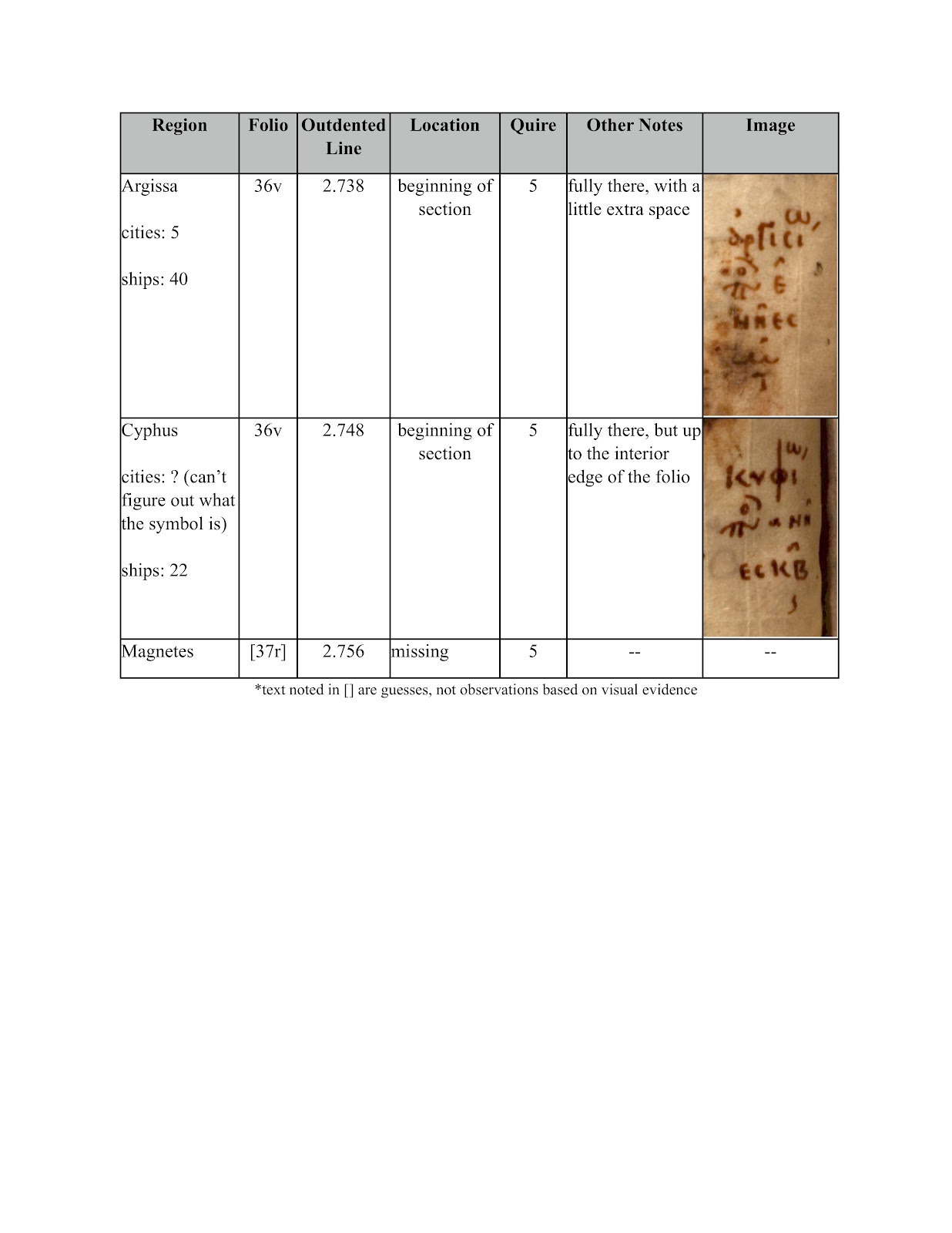
While conducting my investigation, I found it particularly helpful to organize my data into a table. Below is this table which includes the content of each summary scholion, the folio it appears on, the outdented line associated with the region, the relative location of the scholion, the quire number, and another other important notes on the state of the scholion.


Thursday, April 19, 2012

The Scribe as Editor, or What the Images Can Tell Us

An on-going research question addressed by the Homer Multitext in the past two years has been the precise relationship between the manuscript known as the Venetus B and Escorialensis Υ.I.1, or E3 (= West E). As we have noted, the layout of the two manuscripts is virtually identical, the primary difference being that in the Venetus B a second set of scholia was written in the available space approximately two centuries later.

This week I have been editing the text of book 3 of the Iliad in still another manuscript, E4 (Escorialensis Ω.I.12, = West F). In the course of that research I have found several places, all in a relatively brief span of lines, where the Venetus B and E3 differ. This alone would be an interesting finding, but having access to high resolution images of the two manuscripts has allowed me to put together a more precise understanding of these differences than a traditional apparatus alone would have. (Though as we will see, West's apparatus has been very helpful to me in my research.) In fact, the images show that in each case, the Venetus B has been corrected by the scribe, who seems to have been comparing his own text to that of another manuscript. In these places the scribe has chosen to erase the text he originally copied, and insert the new reading. The implications of this practice for our understanding of the relationship between B and E3 will be considered at the end of this post.We will also see in this example that having access to the images can correct and clarify the scholarly apparatus in modern editions in important ways.

Here are some examples that I came across this week:

At 3.102, the Venetus B (folio 43v) reads διακρινθῆτε, but B looks like it has been corrected here. (Zoom up on the image as far as possible to see the evidence of correction.) If we compare it to the corresponding spot on E4 (folio 28r) we see that E4 also reads διακρινθῆτε, but records the alternate reading διακρινθεῖτε above the line.


Detail from folio 28r in E4, showing verse 3.102

The alternate reading in E4, διακρινθεῖτε, is the reading of the text in the Venetus A, T, and significantly, E3. Let us note for now simply that 1) B and E3 have different readings; 2) E4 presents both readings; and finally, most manuscripts in fact have διακρινθῆτε (the seemingly corrected reading of B).

At 3.221,  the Venetus B (folio 46r) once again appears to have been corrected. (This is the view of West, as recorded in his apparatus, presumably based on personal inspection of the manuscript.)  The corrected text reads εἵη, but the original breathing seems to have been a smooth, so that the text would have read εἴη before correction. εἵη (with a rough breathing) is the reading of several papyri and the Venetus A. E3, however, (along with Laurentianus 32.15 and the Genenavensis) reads εἴη (with a smooth breathing).

E4, along with the ninth-century manuscript Z and also Laurentianus 32.3, record still another reading: ἵει. But if we look at the image of E4 (folio 29v), we can see that it too has been corrected:
Detail from folio 29v of E4, showing verse 3.221
West's view (again recorded in his apparatus, and presumably the result of personal inspection) is that the reading of E4 before correction was εἵη (the corrected reading of B). So here is another place where 1) there is division among the manuscripts; 2) the scribe of B has changed his original reading; and 3) E3 matches the reading that B had BEFORE correction.

At 3.301, we have perhaps the most interesting case yet. Several papyri, scholia (from West’s manuscripts M, N, P), the Venetus A, E3, and T read δαμεῖεν here. E4 on the other hand reads μιγεῖεν, which is also found in the lemma of the D scholia (such as in the 9th century manuscript Ve1 [= West Z]) and is written as variant in superscript in T. μιγεῖεν is the text of most mss (except those cited above).

The Venetus B (folio 47v) AFTER correction reads μιγεῖεν, but I think you can see if you zoom up that BEFORE correction it read δαμεῖεν:


Detail of Folio 47v of the Venetus B, showing verse 3.301

(Go to the full image to see this most clearly. It can be difficult to distinguish between bleed through on the other side and the erased text, but I believe that I see the brownish ink of the delta.) Unfortunately, the apparatus of Allen in his editio maior is incorrect here: he cites B as reading δαμεῖεν.

So here is our third case of E3 reading what B had BEFORE correction. The corrections in B are in a darker ink, but they do not appear to be in another or later hand. What seems most likely is that the scribe, after copying the main text of poem from one source, collated it against another source, sometimes correcting the text he had previously written to agree with the second source over the first. I think we can also see that this is what the scribe of E4 has done as well. In addition to the examples discussed here, I have found at least six other places within this same brief span of lines where the text is divided among manuscripts and E4 has clear evidence of having been corrected.

This examination, therefore, suggests two import conclusions. First, it does not seem that E3 is a direct copy of the Venetus B, at least not in its final, edited form. It must be either a copy of B before it was collated against another source, or, what is more likely, B and E3 (which are roughly contemporaneous) were copied from the same exemplar. B's text was collated against a second manuscript, but E3's was not. Secondly, and conceptually more important is our understanding that the scribes of these manuscripts were not simply unthinking copyists, but in fact were making sophisticated editorial choices on the basis of comparison of manuscripts. It is intriguing to see that E4 often corrects to a reading that is found in most manuscripts. Might he have had several sources to look at at once? If so, our Medieval scribes in Constantinople may well have been more like the Alexandrian editors working a millennium before them than they are traditionally given credit for.

A traditional apparatus, such as those of West and Allen, can be extremely useful for comparing the readings of many different manuscripts. But those apparatus can be difficult to understand, and often contain mistakes or omissions. (See that of Allen discussed above. West does not record that at verse 3.231, where there is division among the manuscripts, E4 has been corrected, even though the original text is still quite clear to the eye.) Having access to these images has been invaluable to me as I try to work with the text and understand the relationship between E4 and that of other manuscripts. And in this case, it has given us important evidence about the connection between our "twin" manuscripts, B and E3. It is our hope that the Homer Multitext will likewise greatly aid the process of discovery for other scholars as they undertake their own investigations of the transmission of the text.