I am pleased to announce that the University of Houston is offering a two-year postdoctoral fellowship in Digital Humanities, beginning this January. Please see the details here, and forward this post to anyone you think may be interested. Thank you for your help!
Tuesday, September 11, 2012
Tuesday, September 4, 2012
What's in a Name (of a Manuscript)?
Here are the “shorthand” designations we will use henceforth, and the other possible designations or past names we have used for our five current manuscripts:
HMT designations [names in brackets are other library catalog designations and modern
edition sigla]
Venetus A or Marciana 822 [=Marcianus Graecus Z. 454, Allen’s A, West’s A]
Venetus B or Marciana 821 [=Marcianus Graecus Z. 453, Allen’s B, West’s B]
Marciana 841 [=Marciana Graecus Z. 458, Allen’s U4; West does not include]
Escorial Υ.1.1 [=Escorialensis 294, Escorialensis 291, Allen’s E3, West’s E]
Escorial Ω.1.12 [=Escorialensis 513, Escorialensis 509, Allen’s E4, West’s F]
Why are there so many names for each manuscript? And how did we settle on the names that we now use?
One reason why there are multiple ways to refer to each of our manuscripts is that names or other designations come from two different sources: the libraries which house the manuscripts, and modern editors’ designations or “sigla.” Within each of those sources, in turn, there are additional reasons that names or designations change over time.
Modern editors’ names
When a modern editor collates multiple manuscripts to create a modern edition, s/he might use sigla to designate the manuscripts so that s/he can use those one or two letters and/or numbers in the cramped spaces of a traditional print apparatus criticus. Even the first modern publication of the Venetian manuscripts created such sigla: Villoison in his 1788 edition of Homer’s Iliad with the Scholia called the two manuscripts “A” and “B” for ease of reference in tight print spaces when he compiled the scholia. (You can see digital photographs of Villoison's edition here.) That is the origin of the names “Venetus A” and “Venetus B” (“Venetus” is the Latinate version of “Venice”).
When we look at how two twentieth-century editors have created sigla, we see that each created his own system, resulting in further designations. Allen calls the two manuscripts from the Escorial “E3” and “E4”: he actually collated four manuscripts from the Escorial and designated them 1–4 in the same order as the Escorial’s catalog numbered them, so although these two are the oldest of the four, they end up as “3” and “4.” West, however, uses far fewer manuscripts in his edition, and chose to call these two “E” (=“E3”) and “F” (=“E4”). Allen gave to the Venetian manuscript Marciana 841 the siglum “U4”: in addition to the Venetus A and Venetus B, Allen consulted 13 other manuscripts in Venice at the Marciana, and gave them the sigla U1–13, using a Latinate consonantal “U” for “Venice” since he uses “V” for the manuscripts in the Vatican library. West does not include this manuscript, and so did not create a siglum for it.
We have written before about the problems with the traditional apparatus criticus, both in terms of the difficulties in deciphering from it what a particular manuscript actually has, and in the way it presents barriers to readers, obscuring what the editor has seen in manuscripts in a secret code, as it were. Since we will not have the constraints of a printed page, and because we want to avoid reinforcing the “outsiders not welcome” feel of using such abbreviations, we will not follow in the footsteps of these print editions by using their sigla or by creating our own for the manuscripts.
Up until now, however, we have used these sigla in our writing about the manuscripts and on the website. We have done so because they are short, and therefore handy, and because we learned to do so as part of our academic discipline. But we will avoid using most of these from now on, for the reasons just stated as well as some further considerations I will explain now.
Because “Venetus A” and “Venetus B” are both easy to say and write and widely known names, we will continue to use them as our shorthand for these manuscripts. They have become such established names (and the manuscripts are so important for our textual history of the Iliad) that both Allen in his sigla and West in his use “A” and “B” to designate these manuscripts. But in addition to the hassle of needing to include multiple equivalences any time we refer to the manuscript using the sigla of a modern editor (such as noting the Allen’s E4 = West’s F), using one modern editor’s sigla as our normal reference could imply some scholarly choices or allegiances that we are not meaning to make. So our decision is to use library names and designations rather than sigla from any one modern edition, with the exception of Venetus A and Venetus B because those are so widely known and consistently used.
Library catalogs and shelving
Deciding to use library names and designations wasn’t the end of our decision making process, however, because in these cases, too, there is more than one possible reference. We have had the habit (once again from our training in the discipline) of using Latinate forms for the library names: Marcianus and Escorialensis. But in our desire to welcome nonspecialists to the Homer Multitext, we have decided to avoid such Latinate forms, and use the actual library names, Marciana and Escorial, in our designations for their manuscripts.
Then we must locate them, as it were, within the library, since we have more than one manuscript from each. The libraries that house our manuscripts naturally catalog them, and give them catalog numbers when they do. The Marciana and the Escorial libraries have long histories as institutions, so it is not surprising that they have cataloged their manuscript collections more than once. We have at times used or included designations for the three manuscripts from Venice that were assigned in the catalog compiled by Zanetti in 1740 (http://marciana.venezia.sbn.it/fondo-antico-e-appendice). Those designations, “Marcianus Graecus Z.” plus a number (454, 453, and 458 for our three manuscripts) include the name of the library in the Latinate form, the Latinate designation “Graecus” because Zanetti cataloged the Greek manuscripts separately from the Latin and Italian manuscripts, and the “Z.” to indicate Zanetti’s catalog. So there was both a “Greek 454” (our Venetus A) and, likely, a Latin 454, requiring the specification of the language to distinguish the two. Zanetti also grouped the manuscripts within the language into genres, so the Greek poetry manuscripts all have numbers between 438 and 461.
Similarly at the Escorial, different catalogs have given the two manuscripts different catalog numbers over time: 291 or 294 for what Allen called his “E3” and 509 or 513 for what Allen called his “E4.” Because these numbers have changed over time, using one over the other complicates our designations: even if we choose to use the latest one as the most “current,” it is scholarly practice to include the older numbers so that it is clear that it is indeed the same manuscript. So, just as with using any one editor’s sigla, using one of the Escorial catalogs creates the need for citing the other (294 = 291, e.g.).
Our solution is to use the designation the library has for the shelving of the manuscripts, since that is a designation rooted in some reality about the manuscript as a physical object: namely, where they can be found. For the Escorial, those designations are a Greek letter, followed by two numbers, separated by periods: Escorial Υ.1.1 and Ω.1.12. The numbers from the Marciana of 821, 822, and 841 also refer to their physical place in the library, and are attached to the codices, as this picture of the spine of the Venetus A shows (the label toward the bottom reads “822”).
![]() |
| Spine of Venetus A manuscript, photo published by the Homer Multitext project |
The long history of our discipline shows itself in these changing and accumulating designations. As we reinvent the critical edition, we want to use names that reflect the manuscript as a historical object and are lasting, easy to use, and easy to understand. We hope the designations we have chosen will fulfill those desires.
Wednesday, August 15, 2012
Catalog of Ships Summary Scholia Part Two: Comparing the Υ.1.1 with the Venetus B
A guest post by Stephanie Lindeborg, College of the Holy Cross Class of 2013
In my earlier post on paleographic features in the Catalog of Ships of the Escorial Υ.1.1 manuscript, we established that there are eighteen scholia, located primarily in the interior margin, which summarize the Greek forces by region. Because the Υ.1.1 is often called a “twin” of the Venetus B, it is our practice to run a comparison between the two manuscripts, especially for interesting, unexplored features such as these. My first step was to record and compare the content of each scholion. The Venetus B contains twenty-nine summary scholia, eleven more than I found in the Υ.1.1. The regions noted in the Venetus B scholia match the regions assigned numbers of ships in the poetry. There is no Greek region listed in the poetry that is not accounted for with a scholion in the Venetus B. When I compared the content of analogous scholia between the manuscripts, I found that they were identical. It should be noted that I was working with partial evidence in the Υ.1.1: many of its ship summary scholia have been cut off at the trimmed edges of the manuscript. Because these scholia have a formulaic syntax, I am confident that these “trimmed” scholia are the same in Υ.1.1 as they appear in Venetus B. The presence of eleven more scholia in the Venetus B leads me to believe that the scholia in Υ.1.1 are incomplete. I believe that the eleven scholia “missing” from the Υ.1.1, provided they were ever in the manuscript, had the same content as the scholia that are fully present in the Venetus B.
The next step of my comparison was to analyze the physical appearance of the two manuscripts, starting with the outdents that denotes the beginning of each regional section of the poetry in the Υ.1.1. I wanted to know if the Venetus B uses outdents similarly and, if it does, do they occur in the same places as in the Υ.1.1. The Venetus B without a doubt uses outdents, but I found that it does not use outdents with the same frequency as the Υ.1.1 does. The Υ.1.1 outdents every regional section except for Elis and Doulichion. The Venetus B outdents only nine out of the twenty-nine regional sections (Boeotia, Minya, Phocis, Cephallenia, Methone, Oichalia, Ormenius, Argissa, and Magnetes). When my colleague Neil Curran and I looked at the outdents for all of Book 2 in both manuscripts we found a total of 95 outdents in Υ.1.1. Venetus B had only 41, almost 57% fewer. When I compared line numbers, I found that only one of the lines (Iliad 2.344) outdented in Venetus B was not outdented in Υ.1.1, and Υ.1.1 had 53 additional outdents. While this tells us that the two manuscripts were organized by their respective scribes in similar ways, it also makes evident that they are not perfect twins. While their scribes were working with material that was much the same, they had at least some different ideas about structuring their manuscripts.
My next step was to analyze the placement of the scholia in both manuscripts. Because we have “missing” scholia in the Υ.1.1, establishing a pattern in the Venetus B and correlation between the two manuscripts could help us determine the would-be locations of the “missing” scholia. I compared placement between the manuscripts by noting which line of the main text corresponded with the beginning of each scholion. I found that most (15 out of 18) of the shared scholia began in the same position relative to the main text, or were off by a line or two at most. The most notable exceptions were the first two scholia in both manuscripts. In Υ.1.1, the placement of the first scholion is already irregular just in context of the Υ.1.1 manuscript because it appears well after the lines that discuss Boeotia. In the Venetus B, the scholia on Boeotia and Minya both appear well after their reference in the main text. Both manuscripts avoid putting summary scholia on the first folio that starts the Catalog of Ships, but, while both manuscripts are irregular, the placement of their first scholia is different. Aside from the first two scholia in both manuscripts, I found that the placement of scholia in the Venetus B matches the placement of the scholia in the Υ.1.1 (for a summary of this placement see the chart below). This pattern and correlation allows us to predict on which folios the “missing” scholia should have appeared and roughly where in the margin we should be looking for the visual evidence.
Based on comparison with the Venetus B, I believe that scholia are missing from the following folios of the Υ.1.1: 32r, 33r, 34v, 35r, 35v, and 37r. Of these folios 32r, 33r, 35r, and 37r have narrow interior margins. In this situation it is plausible that the summary scholia were cut off when the manuscript was trimmed and rebound. To see for yourself, here is folio 32r (click on the caption to open the image in a zoomable format):
![]() |
| Escorial Y.1.1, folio 32r: example of a narrow interior margin |
Exceptions to this pattern are folios 34v and 35v, which have margins that appear wide enough to hold a scholia. While we might not be able to hope for all of the scholia to be present on folios such as these, it is surprising not to see any traces in the interior margins. If you compare a folio like 35v to 32r you can see the difference in the margin size.
![]() |
| Escorial Y.1.1, folio 35v: example of a wider interior margin |
When I compare the size of the margins to folio sides that have summary scholia but only in part (such as 36r), I am even more surprised that these folio sides with wider margins lack any trace of summary scholia.
![]() |
| Escorial Y.1.1, folio 36r, example of narrow margin on which ship summary scholia have been cut off in rebinding |
![]() |
| Close-up of one of the ship summary scholia from 36r (Methone) that has been cut off in rebinding |
The lack of scholia on 34v and 35v is the strongest evidence for my hypothesis that the scribe of the Υ.1.1 did not include as many summary scholia as in the Venetus B from the start.
In the previous post, we considered whether the scribe may have eliminated scholia about regions he deemed less important. Based only on my knowledge of the Υ.1.1, I could not exclude any of the “missing” scholia from the list and so could not come to a confident conclusion on that question. If we were to eliminate from the list the scholia that appear on 32r, 33r, 35r, and 37r because it is more likely they were originally there, our list of supposedly unimportant places narrows to: Rhodes, Syme, Phylace, and Pherae. This narrowed list still does not lend much credence to the assumption. Rhodes in particular is especially noted in the epic poetry with praises for its abundant resources and its connection to Tlepolemus, a son of Heracles.
My last point of comparison is in the quire arrangement. The Venetus B is organized mostly into quaternions, and has a total of 42 quires. The Υ.1.1 is much more irregular in terms of the number of folio in a quire (it ranges from 6 to 8), but also contains a total of 42 quires. The exact content of all the corresponding quires is a subject for future investigation. For Book Two we can say that the first five summary scholia appear at the end of the fourth quire in both manuscripts, and subsequently the rest of the scholia appear in each manuscript’s fifth quire. This is interesting to us when we consider the claim that the manuscripts are “twins.” The fact that the content of the quires is similar (down to what appears in which quire), at least true for this specific situation, is strong evidence for the claim.
In my investigation of the Venetus B’s relationship to the Υ.1.1, I constructed a comparative table to aid my analysis. It proved especially helpful to compare numerous features at the same time. Below is the table, which lists folio sides, outdents, relative location of the scholia, and quire number.
Saturday, August 11, 2012
Catalog of Ships Summary Scholia in the Escorial Υ.1.1
Guest post by Stephanie Lindeborg, College of the Holy Cross Class of 2013
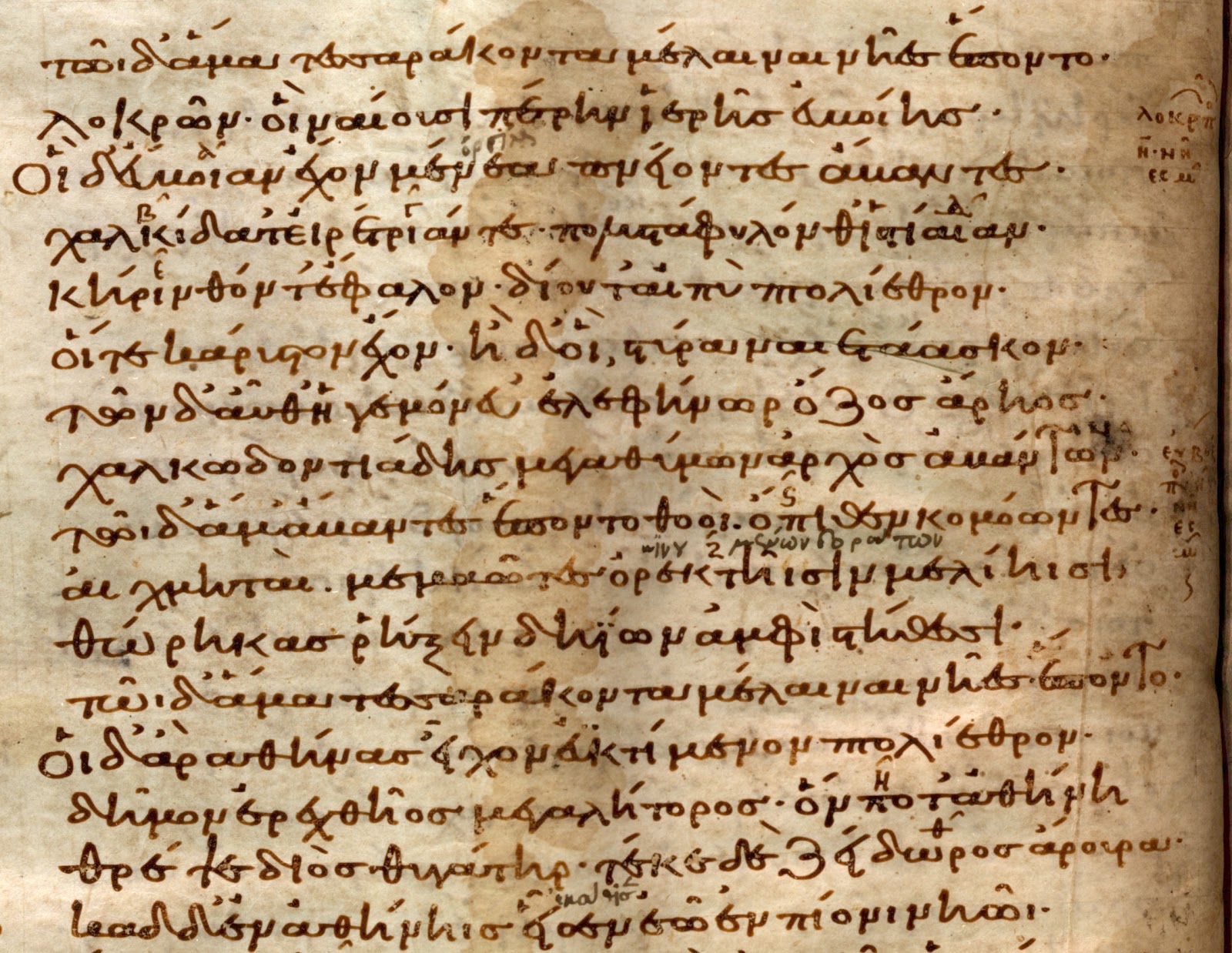
The Catalog of Ships is the last half of Iliad Book 2, in which the forces of the Greek army are listed and summarized. Looking at the Escorial Υ.1.1 manuscript, I, along with my colleague Neil Curran, discovered that the scribe included paleographic features in addition to the main scholia in conjunction with the Catalog. The Υ.1.1 and the Venetus B feature “summary scholia” that denote the number of cities (if applicable) in each Greek region and the number of ships they brought. (The scholia in Venetus B will be discussed in more depth in a subsequent post). It would appear that these numbers are derived directly from the poetry. It is easy enough to see that the number of ships are directly stated in the poetry. The number of cities would appear to be the number of the cities listed by name in each section of the main text. For an example of what I mean by “summary scholia,” the scholion on 31v of the Υ.1.1 reads: “Λοκρῶν πολεὶς Η νῆες Μ” and translates to: “The eight cities of Locris [brought] forty ships.” (The caption links to the image of the full page with this portion highlighted.)
The format is almost always the same in each summary scholion (i.e., region, number of cities, number of ships). Within the Catalog further visual features used by the scribe help clarify where each section of the catalog starts. In the Υ.1.1, this visual distinction is accomplished by outdenting the beginning line of each regional section:
For the purposes of these investigations, I define the regions as each place which is said in the poetry to have brought a specific number of ships (so because the poetry says Mycenae brought one-hundred ships, Mycenae is noted as a unique region). The names of each region I derive from the scholia which summarize them. The Υ.1.1 outdents all but two of the twenty-nine so defined regions.
The twenty-nine Greek regions include, in order of appearance: Boeotia, Minya, Phocis, Locris, Euboea, Athens, Salamis, Argos, Mycenae, Lacedaemonia, Pylos, Arcadia, Elis, Doulichion, Cephallenia, Aetolia, Crete, Rhodes, Syme, Nisyros, Phthia, Phylace, Pherae, Methone, Oichalia, Ormenius, Argissa, Cyphus, and Magnetes. Only eighteen of these regions are marked by summary scholia in the Υ.1.1 in its current state, leaving eleven without. The following regions are missing such a summary scholion: Athens, Salamis, Argos, Arcadia, Rhodes, Syme, Nisyros, Phthia, Phylace, Pherae, and Magnetes. I will consider two possibilities to account for the missing scholia. The first is that when the manuscript was trimmed and rebound these scholia were cut off. The second possibility is that these scholia were never added to the manuscript in the first place, omitted either purposely or accidentally by the scribe.
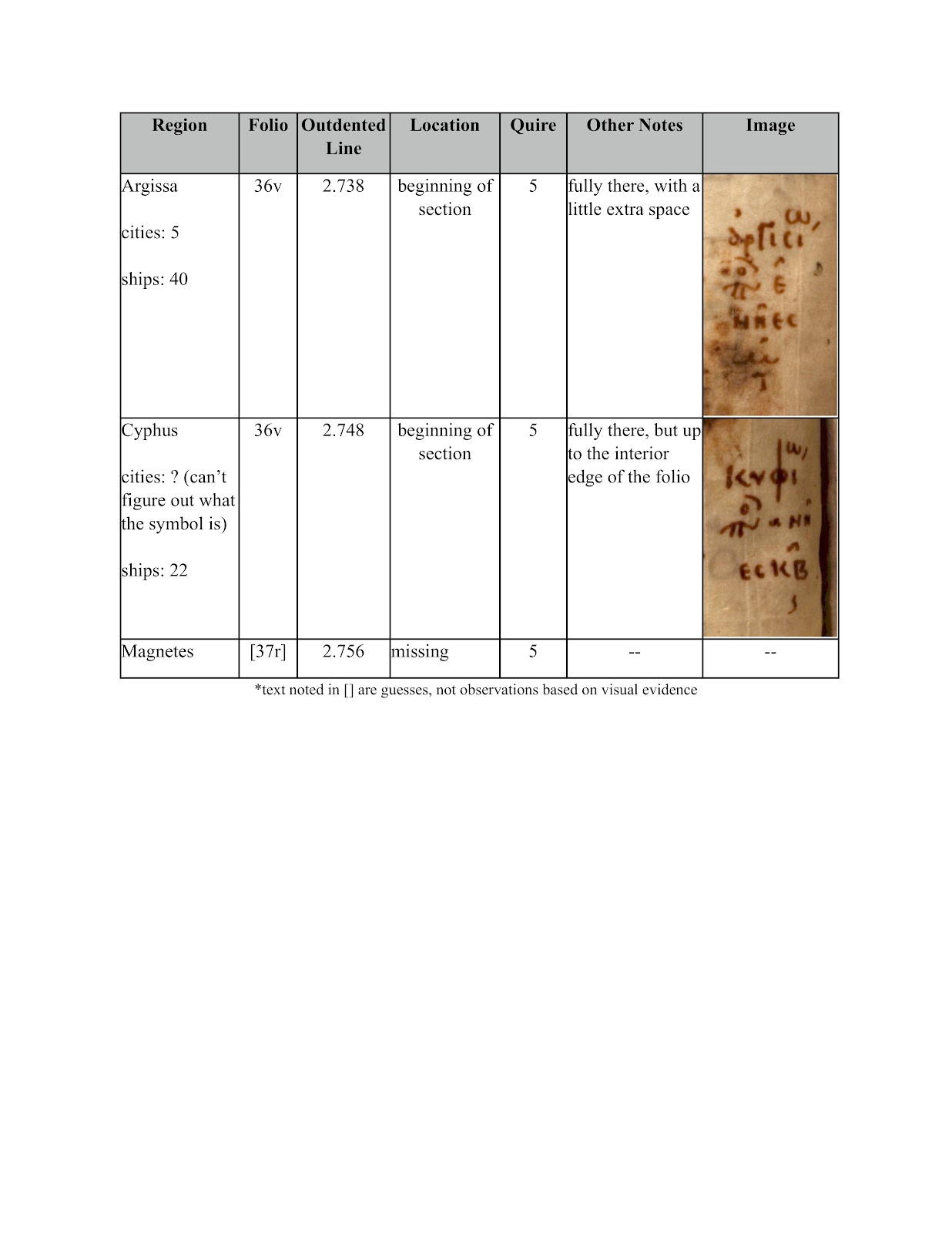
The evidence that they were lost in the trimming process is compelling. Of the eighteen scholia that are present only nine (Locris, Euboea, Mycenae, Lacedaemonia, Pylos, Elis, Doulichion, Argissa, and Cyphus) are present in their entirety and very few of those leave any space between the edge of the scholion and the edge of the folio. Four of the scholia (Boeotia, Minya, Phocis, and Cephallenia) are cut off about halfway through but are still fairly discernible. Five (Aetolia, Crete, Methone, Oichalia, and Ormenius) are almost entirely cut off, containing at most only a few letters. These were more difficult to identify as their names were not easily picked out. My identification of these scholia was made based on the content of the main lines and what I could make out (for example I identified Ormenius because it was near the lines on Ormenius in the main text and the numeral for forty was visible, which matches the number stated in the main text). I further cross-checked these identifications with the Venetus B, which I will discuss in a subsequent post.
If we could assume that the eleven missing scholia were cut off when the manuscript was trimmed, then we could simply lament the loss of the physical evidence and concern ourselves with other questions such as the twin nature of the Υ.1.1 and the Venetus B manuscripts. However, we must consider the possibility that some of these scholia never made it into the manuscript. The simplest explanation in that case would be that the scribe unintentionally omitted them. The gaps of missing scholia are restricted to a whole folio side, meaning there are no folio sides that have some but not all of the scholia they could have. It is possible that the scribe accidentally skipped a whole folio side when adding the ship summaries.
After ascertaining the quire arrangement of the Υ.1.1, I was able to look at whether the quires had anything to do with why these summary scholia are missing in the Υ.1.1. Because manuscripts were typically composed in several passes, it is a serious possibility that scribes could accidentally skip entire quires when adding certain features. This is something we always investigate when we have seemingly incomplete sets of features. The Catalog begins on 30v and the summary scholia start appearing on 31r. 30v through 31v are the last three folio sides of the fourth quire. 32r starts the fifth quire which continues through 39v, the end of the Catalog and the end of Book 2. The first three scholia that are missing (Athens, Salamis, and Argos) ought to appear at the beginning of the fifth quire. It is also probable that these three were cut off when the manuscript was rebound. Since the rest of the missing scholia are contained within a quire that has many of the summary scholia present, the theory that the scribe could have skipped over an entire quire is impossible.
The other possibility is that the scribe purposely excluded certain scholia, perhaps because he deemed them of lesser importance. But that motivation would mean that the “less important” scholia may have included: Athens, Salamis, Argos, Arcadia, Rhodes, Syme, Nisyros, Phthia, Phylace, Pherae, and Magnetes. It's rather hard to believe that this list of places could be deemed unimportant, when Phthia is the homeland of Achilles and other great heroes are named in conjunction with these places (i.e., Ajax and several sons of Heracles). There is no evidence to say that the scribe skipped places that did not bring a large number of ships for some of the missing ones brought as many as forty ships (Phylace) and he includes places that brought as few as seven (Methone). There seems to be no distinguishing characteristic that sets aside the missing places from those that are present.
In the Υ.1.1, these scholia raise questions about how the manuscript was composed. One of the striking features in the Υ.1.1 are the first three summary scholia. While all the others in the Υ.1.1 are located in the interior margin, the first three in the Υ.1.1 are instead placed in the exterior margin. There is no clear reason as to why these scholia are located in the exterior, nor why the scribe puts no other summary scholia in the exterior. We can only surmise that it was a conscious choice made by the scribe and that it made more sense to him not to continue putting the scholia in the exterior. The fact that these scholia are in the exterior tells us that they were planned to fit outside of the main scholia and so were, more likely than not, written after the main scholia. They were either written before the scribe finished with a folio or as a second pass through Book 2. If the former is true, that might explain why some scholia are missing. Including another type of scholia in another location on the page might have complicated the process enough that the scribe forgot to include some of the scholia he was supposed to. If the scribe were adding the scholia as a separate set, going back through the entire Catalog to add them in a separate pass specifically for that purpose rather than as he worked on each folio individually, then it is highly unlikely that he would have forgotten to include some of them. I conclude, therefore, that the summary scholia were probably not added in a second pass in the Υ.1.1.
While conducting my investigation, I found it particularly helpful to organize my data into a table. Below is this table which includes the content of each summary scholion, the folio it appears on, the outdented line associated with the region, the relative location of the scholion, the quire number, and another other important notes on the state of the scholion.
The Catalog of Ships is the last half of Iliad Book 2, in which the forces of the Greek army are listed and summarized. Looking at the Escorial Υ.1.1 manuscript, I, along with my colleague Neil Curran, discovered that the scribe included paleographic features in addition to the main scholia in conjunction with the Catalog. The Υ.1.1 and the Venetus B feature “summary scholia” that denote the number of cities (if applicable) in each Greek region and the number of ships they brought. (The scholia in Venetus B will be discussed in more depth in a subsequent post). It would appear that these numbers are derived directly from the poetry. It is easy enough to see that the number of ships are directly stated in the poetry. The number of cities would appear to be the number of the cities listed by name in each section of the main text. For an example of what I mean by “summary scholia,” the scholion on 31v of the Υ.1.1 reads: “Λοκρῶν πολεὶς Η νῆες Μ” and translates to: “The eight cities of Locris [brought] forty ships.” (The caption links to the image of the full page with this portion highlighted.)
![]() |
| Summary scholion for Locris on Υ.1.1 31v |
![]() |
| Note the 'outdenting' of the two lines beginning with οἱ, Iliad 2.536 and 2.546, on Υ.1.1 31v |
The twenty-nine Greek regions include, in order of appearance: Boeotia, Minya, Phocis, Locris, Euboea, Athens, Salamis, Argos, Mycenae, Lacedaemonia, Pylos, Arcadia, Elis, Doulichion, Cephallenia, Aetolia, Crete, Rhodes, Syme, Nisyros, Phthia, Phylace, Pherae, Methone, Oichalia, Ormenius, Argissa, Cyphus, and Magnetes. Only eighteen of these regions are marked by summary scholia in the Υ.1.1 in its current state, leaving eleven without. The following regions are missing such a summary scholion: Athens, Salamis, Argos, Arcadia, Rhodes, Syme, Nisyros, Phthia, Phylace, Pherae, and Magnetes. I will consider two possibilities to account for the missing scholia. The first is that when the manuscript was trimmed and rebound these scholia were cut off. The second possibility is that these scholia were never added to the manuscript in the first place, omitted either purposely or accidentally by the scribe.
The evidence that they were lost in the trimming process is compelling. Of the eighteen scholia that are present only nine (Locris, Euboea, Mycenae, Lacedaemonia, Pylos, Elis, Doulichion, Argissa, and Cyphus) are present in their entirety and very few of those leave any space between the edge of the scholion and the edge of the folio. Four of the scholia (Boeotia, Minya, Phocis, and Cephallenia) are cut off about halfway through but are still fairly discernible. Five (Aetolia, Crete, Methone, Oichalia, and Ormenius) are almost entirely cut off, containing at most only a few letters. These were more difficult to identify as their names were not easily picked out. My identification of these scholia was made based on the content of the main lines and what I could make out (for example I identified Ormenius because it was near the lines on Ormenius in the main text and the numeral for forty was visible, which matches the number stated in the main text). I further cross-checked these identifications with the Venetus B, which I will discuss in a subsequent post.
If we could assume that the eleven missing scholia were cut off when the manuscript was trimmed, then we could simply lament the loss of the physical evidence and concern ourselves with other questions such as the twin nature of the Υ.1.1 and the Venetus B manuscripts. However, we must consider the possibility that some of these scholia never made it into the manuscript. The simplest explanation in that case would be that the scribe unintentionally omitted them. The gaps of missing scholia are restricted to a whole folio side, meaning there are no folio sides that have some but not all of the scholia they could have. It is possible that the scribe accidentally skipped a whole folio side when adding the ship summaries.
After ascertaining the quire arrangement of the Υ.1.1, I was able to look at whether the quires had anything to do with why these summary scholia are missing in the Υ.1.1. Because manuscripts were typically composed in several passes, it is a serious possibility that scribes could accidentally skip entire quires when adding certain features. This is something we always investigate when we have seemingly incomplete sets of features. The Catalog begins on 30v and the summary scholia start appearing on 31r. 30v through 31v are the last three folio sides of the fourth quire. 32r starts the fifth quire which continues through 39v, the end of the Catalog and the end of Book 2. The first three scholia that are missing (Athens, Salamis, and Argos) ought to appear at the beginning of the fifth quire. It is also probable that these three were cut off when the manuscript was rebound. Since the rest of the missing scholia are contained within a quire that has many of the summary scholia present, the theory that the scribe could have skipped over an entire quire is impossible.
The other possibility is that the scribe purposely excluded certain scholia, perhaps because he deemed them of lesser importance. But that motivation would mean that the “less important” scholia may have included: Athens, Salamis, Argos, Arcadia, Rhodes, Syme, Nisyros, Phthia, Phylace, Pherae, and Magnetes. It's rather hard to believe that this list of places could be deemed unimportant, when Phthia is the homeland of Achilles and other great heroes are named in conjunction with these places (i.e., Ajax and several sons of Heracles). There is no evidence to say that the scribe skipped places that did not bring a large number of ships for some of the missing ones brought as many as forty ships (Phylace) and he includes places that brought as few as seven (Methone). There seems to be no distinguishing characteristic that sets aside the missing places from those that are present.
In the Υ.1.1, these scholia raise questions about how the manuscript was composed. One of the striking features in the Υ.1.1 are the first three summary scholia. While all the others in the Υ.1.1 are located in the interior margin, the first three in the Υ.1.1 are instead placed in the exterior margin. There is no clear reason as to why these scholia are located in the exterior, nor why the scribe puts no other summary scholia in the exterior. We can only surmise that it was a conscious choice made by the scribe and that it made more sense to him not to continue putting the scholia in the exterior. The fact that these scholia are in the exterior tells us that they were planned to fit outside of the main scholia and so were, more likely than not, written after the main scholia. They were either written before the scribe finished with a folio or as a second pass through Book 2. If the former is true, that might explain why some scholia are missing. Including another type of scholia in another location on the page might have complicated the process enough that the scribe forgot to include some of the scholia he was supposed to. If the scribe were adding the scholia as a separate set, going back through the entire Catalog to add them in a separate pass specifically for that purpose rather than as he worked on each folio individually, then it is highly unlikely that he would have forgotten to include some of them. I conclude, therefore, that the summary scholia were probably not added in a second pass in the Υ.1.1.
While conducting my investigation, I found it particularly helpful to organize my data into a table. Below is this table which includes the content of each summary scholion, the folio it appears on, the outdented line associated with the region, the relative location of the scholion, the quire number, and another other important notes on the state of the scholion.
Thursday, August 9, 2012
πάθει, μάθος
When I ran the automated build to publish our collection of xml diplomatic editions as blogged here earlier this week, I had inadvertently turned off a final automated validation on all of the texts to be published, and some errors crept into the published package. I've rerun the build and republished the texts. If your system is automatically using the latest version of a Nexus artifact, you'll now get the correct versions. If you are manually setting the version, please update it to 2012.8.9, or to download manually, get the zip file from the 2012.8.9 directory here.
Apologies to those who were mystified by the errors in the initial release. We're still learning how to automate the management of our archives as effectively as possible, and will continue to blog here our successes and failures alike.
Monday, August 6, 2012
Release of archival text editions
A recent post noted the reorganization of our downloadable archive of image data. Today, we have published a first package of diplomatic editions of texts.
In contrast to our relatively static collection of large, binary data files of images, we expect to release new packages updating or expanding our archive of TEI-compliant editions whenever new material is ready. We are managing these releases with the Nexus repository management system, hosted at the University of Houston High Performance Computing Center (briefly noted here). Nexus organizes named "artifacts" (as it terms published objects) in groups, with further, specific identifiers distinguishing each published version. Most significantly for the on-going management of the HMT project's digital resources, Nexus supports the automated management of dependencies used in build systems like maven or gradle. This means that when we want to automate a task working with our editions, we can simply declare that our task depends on a particular version of the artifact, and the zipped file will be automatically retrieved over the internet and unpacked locally. (For the technically inclined, I recently blogged a note elsewhere about using automated dependency management in small disciplines like Classics.)
In addition to the TEI-compliant XML files, the package includes a CTS TextInventory file documenting the citation scheme of each edition, and how it maps onto the document's XML markup. README files summarize the contents and editorial status of each section of the archive. This release includes initial, unverified diplomatic editions of 32 Iliadic texts from papyrus sources, the Iliadic text and scholia from Iliad 1-6 in the Venetus A manuscript, and other texts from the first eleven folios of the Venetus A manuscript.
The package is named hmt-editions, and it belongs to the group org.homermultitext. For this package, a date string is used for the version identifier (formatted as YYYY.MM.DD). You can search for "hmt-editions" from the nexus server at beta.hpcc.uh.edu/nexus, or directly download the zip file from this URL.
If you want to add a dependency to this package in your maven or gradle build, use the following maven coordinates (in whatever syntax is appropriate to your build system):
groupId: org.homermultitext
artifactId: hmt-editions
version: 2012.8.7
type: zip
Friday, August 3, 2012
ICT · The Image Citation Tool
The Homer Multitext has developed an Image Citation Tool for use with digital images served by the CITE Image Service.
Humanist scholarship is the act of forging new connections between ideas, and placing those connections before the eyes of readers. Those readers must be free and empowered to judge the value of the new connections.
The heart of humanist scholarship, then in quotation. Robert Sokolowski calls quotation a ‘curious conjunction of begin able to name and to contain’;* V.A. Howard is more succinct: quotation is ‘replication-plus-reference’.** We would re-phrase this as “reproduction plus citation”.
Reproduction in a quotation allows us to talk about a particular artifact of human thought without the burden of reproducing its entire context. As a practical matter, it is easier to say “Μῆνιν ἄειδε θεὰ Πηληϊάδεω Ἀχιλῆος” than to reproduce the whole of the Iliad.
Citation in a quotation provides a link from the reproduced selection back to context of that selection. “Iliad 1.1” names our quotation, as Howard says, but also invites the reader to explore Iliad 1.2, all of Book 1 of the Iliad, or the whole poem.
This is easy stuff. We were all taught to do it early in our educations, and we take it for granted.
It is easy, that is, with texts. Images are a different matter. How do you “quote” from an image? Most scholars use images from time to time in their work; few of those uses meet the rigorous standards of “quotation” that we take for granted with texts. The general practice is to open a digital image in an image-editor, cut out the area of the image under discussion, and paste that image into a document or web-page. If the image is cited, the citation is often to a page in a book that has published a version of the image, a museum’s accession number identifying an original work of art, or a URL to a web-page on which a digital version of the image appears. The citation does not provide a path from the selection to its context.
Nor is this kind of “image quotation” actionable in the way that a textual quotation (reproduction+citation) is. Given “Iliad 1.1”, it is simple to answer the question “What comes next?”. It is simple to know that “Iliad 1.1–1.10” includes Iliad 1.5. Given a cut-copied-pasted snippet of a digital image, and perhaps a citation to a web-page, it is not possible to answer with any degree of precision “Where is this snippet in its larger context? What parts of the image are adjacent to this snippet?” Given two snippets, it would require considerable computation to determine whether Snippet A contains Snippet B.
Since the Homer Multitext is committed to image-based scholarly editing, and subsequent discussion and argument based closely on digital imagery of manuscripts and papyri, we have worked to developed a means of quoting images as rigorously, and usefully, as we can quote texts.
The CITE Image Service allows us to identify images with canonical citations in URN-notation. These URNs take the form: urn:cite:hmt:chsimg.VA094VN-0597. This points to a notional image, which might be delivered at any scale, or by services hosted on various machines with various addresses.
A CITE Image URN can take a suffix that identifies a rectangular region-of-interest: urn:cite:hmt:chsimg.VA094VN-0597:0.3833,0.2441,0.0783,0.0463. This URN+ROI can resolve to a “quotation”, that is the region-of-interest on its own, or to a view of the larger image with the region-of-interest highlighted. These image-ROIs canonically cited with URN notation are concise, precise, and machine-actionable mechanisms for image quotation in the best tradition of humanist scholarship.
To help ourselves, our collaborators, and anyone else interested in working with the openly licensed images in our Homer Multitext Image Collection, we have developed a web-based tool for defining regions-of-interest on our digital images and capturing canonical citations for them. This is the Image Citation Tool.
A lengthy introduction to the tool and its use are included in our Homer Multitext documentation pages. Downloadable source-code for the tool—a relatively simple web-application in HTML, CSS, and Javascript—is available from the HMT’s code repository.
* Sokolowski, Robert. “Quotation.” The Review of Metaphysics 37.4 (1984) : 699-723. Print. 24 May 2011.
** Howard, V.A., “On Musical Quotation”, Monist 58 (1974) 310.
Humanist scholarship is the act of forging new connections between ideas, and placing those connections before the eyes of readers. Those readers must be free and empowered to judge the value of the new connections.
The heart of humanist scholarship, then in quotation. Robert Sokolowski calls quotation a ‘curious conjunction of begin able to name and to contain’;* V.A. Howard is more succinct: quotation is ‘replication-plus-reference’.** We would re-phrase this as “reproduction plus citation”.
Reproduction in a quotation allows us to talk about a particular artifact of human thought without the burden of reproducing its entire context. As a practical matter, it is easier to say “Μῆνιν ἄειδε θεὰ Πηληϊάδεω Ἀχιλῆος” than to reproduce the whole of the Iliad.
Citation in a quotation provides a link from the reproduced selection back to context of that selection. “Iliad 1.1” names our quotation, as Howard says, but also invites the reader to explore Iliad 1.2, all of Book 1 of the Iliad, or the whole poem.
This is easy stuff. We were all taught to do it early in our educations, and we take it for granted.
It is easy, that is, with texts. Images are a different matter. How do you “quote” from an image? Most scholars use images from time to time in their work; few of those uses meet the rigorous standards of “quotation” that we take for granted with texts. The general practice is to open a digital image in an image-editor, cut out the area of the image under discussion, and paste that image into a document or web-page. If the image is cited, the citation is often to a page in a book that has published a version of the image, a museum’s accession number identifying an original work of art, or a URL to a web-page on which a digital version of the image appears. The citation does not provide a path from the selection to its context.
Nor is this kind of “image quotation” actionable in the way that a textual quotation (reproduction+citation) is. Given “Iliad 1.1”, it is simple to answer the question “What comes next?”. It is simple to know that “Iliad 1.1–1.10” includes Iliad 1.5. Given a cut-copied-pasted snippet of a digital image, and perhaps a citation to a web-page, it is not possible to answer with any degree of precision “Where is this snippet in its larger context? What parts of the image are adjacent to this snippet?” Given two snippets, it would require considerable computation to determine whether Snippet A contains Snippet B.
Since the Homer Multitext is committed to image-based scholarly editing, and subsequent discussion and argument based closely on digital imagery of manuscripts and papyri, we have worked to developed a means of quoting images as rigorously, and usefully, as we can quote texts.
The CITE Image Service allows us to identify images with canonical citations in URN-notation. These URNs take the form: urn:cite:hmt:chsimg.VA094VN-0597. This points to a notional image, which might be delivered at any scale, or by services hosted on various machines with various addresses.
A CITE Image URN can take a suffix that identifies a rectangular region-of-interest: urn:cite:hmt:chsimg.VA094VN-0597:0.3833,0.2441,0.0783,0.0463. This URN+ROI can resolve to a “quotation”, that is the region-of-interest on its own, or to a view of the larger image with the region-of-interest highlighted. These image-ROIs canonically cited with URN notation are concise, precise, and machine-actionable mechanisms for image quotation in the best tradition of humanist scholarship.
To help ourselves, our collaborators, and anyone else interested in working with the openly licensed images in our Homer Multitext Image Collection, we have developed a web-based tool for defining regions-of-interest on our digital images and capturing canonical citations for them. This is the Image Citation Tool.
A lengthy introduction to the tool and its use are included in our Homer Multitext documentation pages. Downloadable source-code for the tool—a relatively simple web-application in HTML, CSS, and Javascript—is available from the HMT’s code repository.
References
* Sokolowski, Robert. “Quotation.” The Review of Metaphysics 37.4 (1984) : 699-723. Print. 24 May 2011.
** Howard, V.A., “On Musical Quotation”, Monist 58 (1974) 310.
Subscribe to:
Posts (Atom)